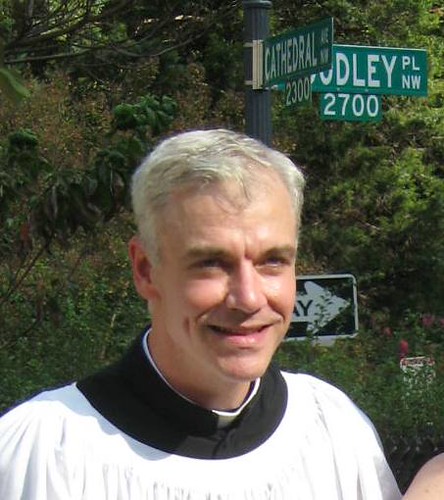
Sunday, October 02, 2011

Stumbling and Being Lifted Up

A sermon for the Sixteenth Sunday after Pentecost, October 2, 2011. The lectionary readings are Isaiah 5:1-7, Psalm 80: 7-14, Philippians 3:4b-14, and Matthew 21:33-46.


At the age of 47, I find myself sometimes wondering, “At what age can I begin using a walking cane, without looking silly?” It’s not because I want the “look”, perhaps of an English gentleman or country vicar. It’s because I tend to stumble. I stumble on curbs, and sidewalks. I stumble in hallways. I fall up steps, and thankfully not down them. But it seems (to me, anyway) like I stumble easily.

Jesus talks about people stumbling in today’s Gospel. But it’s worse than just stumbling. They fall and become broken, or crushed.

The context for this Gospel, this allegory Jesus tells, is crucial. It takes place in the midst of high drama. Jesus has just entered Jerusalem, sitting on a donkey—the events we commemorate on Palm Sunday. The people on the streets have greeted him with shouts of Hosanna, signaling their perception that Jesus might be more than an itinerant preacher, more than some fringe radical, but actually might be the messiah who will save and usher in a whole new realm. Jesus goes to the temple and he overturns the tables of the moneychangers. He’s making a name for himself.

And so, when Jesus returns to the temple the next day, the temple priests, the religious leaders, see him coming and they stand their ground. And so, here in the temple, in front of the religious authorities, and probably with other people looking and listening in as best they can, Jesus tells the allegory we hear in today’s Gospel.
Jesus knows the passage from Isaiah that was our first lesson this morning. Jesus knows Isaiah as well as the temple leaders. They all known the imagery of a vineyard representing Israel, God’s chosen people. A “beloved vineyard,” which is tended with care and dedication. God has poured himself into the vineyard, and yet the vineyard is not producing. It just lies there.

Jesus builds on this image when he tells his story to the religious leaders. Jesus is reminding them that the temple is a vineyard, the people of Israel are a vineyard, and God has continually sent prophets and messengers to offer help, to point out the broken places and suggest remedies and correction, but over and over again, the prophets have been rejected. And now, God sends Jesus, God’s own son, the prophet of prophets, the gardener of gardeners, the best vinedresser around—and again, the religious authorities are rejecting the teaching of Jesus, and this rejection will build until they put him to death on a cross.

There are several important points to make about this allegory. The first is to be clear that this story is not about the followers of Jesus, who would later be called Christians, replacing the Jews as God’s people. It’s not a “Jewish-Christian” thing. It’s a “leader-people” thing. It’s the Jewish leaders who are full of themselves, corrupt, defensive, and fearful of having to adjust their power and privilege, who reject Jesus. The Jewish people themselves—which include the outsiders, the misfits, the so-called “sinful”—it’s these who embrace Jesus as a good man. They like Jesus, who eats with them, and laughs with them, and enjoys life like they do. They see Jesus as a holy prophet, perhaps the messiah. Many come to see him as the Son of God.

At some level, we might say, “Oh, then this story is about religious leaders who were corrupt and still are, so it’s not about me.” But I think the words of Jesus invite us to ask questions about authority—where do we look for authority? To whom do we give our allegiance? Who do we picture in our head approving or disapproving, when we make decisions, as we live our lives?

I’ve been thinking a lot about this question of “who we look to for authority” since last Sunday, when Bishop Christopher Senyonjo was with us. We had a number of visitors and I was grateful for that. But one visitor, in particular, turned out to be a young man from a very traditional and conservative part of the Anglican Communion. He came and listened. (And I noticed he had no problem with our fellowship or our food at the reception!) But then he wrote an article for his organization. The article has this false tone of objectivity, but in a very subtle way, suggests that Bishop Senyonjo is not what he appears to be. [The article for the Institute on Religion & Democracy can be found here. ] The subtext to the article is that Seyonjo is a revisionist Christian who is leading fringe followers away from traditional teachings of Christianity.

The temple priests and religious leaders of Jesus’ day would be very pleased with the article.

Do we follow structures and leaders who make us feel safe, support our prejudices, and make us comfortable with the power and privilege we wield? Or do we follow Jesus Christ who seems again and again to challenge our perspective, to open doors we didn’t even realize were closed, and to welcome every person? Some traditionally religious people suggest than one should have one’s entire life cleaned up, morally pure, doctrinally righteous and blameless—and THEN, (and only then)—the one is allowed to approach God. My understanding of Jesus is that HE is the only one who is blameless, and the rest of us have a lot of work to do, every day of our life, as long as we are this side of heaven. Life is stumbling and getting back up again.

Jesus suggests that the religious leaders of his day may very well stumble and fall on God’s truth, God’s revelation in Jesus. And their fall may well be fatal.

But for the one who puts trust in Jesus, who attempts to follow God in community, we do stumble from time to time. And we might even fall. But Christ is there to help us up. He sometimes comes in the form of extra strength we didn’t know we had. Christ sometimes comes in a new way of thinking that lifts us up off the ground. And Christ sometimes comes through other people who give us a hand, who give us an arm to hold on to or a shoulder to lean on, and who sometimes literally pick us up and carry us where we need to go.

In today’s Epistle reading, St. Paul puts it beautifully as he says, “I want to know Christ and the power of his resurrection and the sharing of his sufferings by becoming like him in his death, if somehow I may attain the resurrection from the dead.

Not that I have already obtained this or have already reached the goal; but I press on to make it my own, because Christ Jesus has made me his own.” Paul goes on, “Beloved, I do not consider that I have made it my own; but this one thing I do: forgetting what lies behind and straining forward to what lies ahead, I press on toward the goal for the prize of the heavenly call of God in Christ Jesus.” (Philippians 10b-14)

Friends, let us press on in following the Christ who invites, who heals, who raises up when we stumble, and who raises us up even to eternal life. In the name of the Father, and of the Son, and of the Holy Spirit. Amen.

Sunday, September 25, 2011

Lives that follow lips


A sermon for the Fifteenth Sunday after Pentecost, September 25, 2011. The lectionary readings are Exodus 17:1-7, Psalm 78:1-4, 12-16, Philippians 2:1-13, and Matthew 21:23-32.


From time to time in the Gospels we hear about the Pharisees. The Pharisees were a particular group of religious people who were extremely concerned with following the laws of God as closely as possible. Many were good and faithful Jews. But some were all caught up in appearances. They worried about how they looked (what people thought when they saw them). They worried about how they sounded, as they spoke to one another and said their prayers. And they worried about how people regarded them, whether they were seen to be people of authority or not. And so, when Jesus comes on the scene—preaching, teaching and healing—the Pharisees are curious and they feel threatened.

They try to get Jesus into a conversation about authority—by what authority does he teach? Where did he go to school? Who did he study with? What are his credentials? But Jesus refuses to get bogged down by these people. Instead, he looks at them, and he looks at the people who are gathered, and Jesus sees a more important point to be made. Almost to prove to the Pharisees how out of place their question is, Jesus asks them the strange question about John the Baptist. Sure enough, it stumps the Pharisees, and when they can’t answer it, Jesus moves on to his larger point.

Jesus tells this story about two children. The first is asked to go into the vineyard and do some work. Evidently, this child has other things on his mind, so he tells his father, no. But after a little while, this first child feels bad about what he has said, and so, he goes to the father and apologizes.
He repents not only of his rudeness, but also, of his unwillingness to work. Presumably, the father accepts his repentance and then the child goes into the vineyard and does a fine job. There is also another child, a second son. And this one is very polite and initially tells the father, “Sure, of course I’ll go and work in the vineyard. But the second child doesn’t follow through.

The Pharisees are listening to this story, but they’re listening with a particular context and tradition. The Pharisees had a teaching that almost seemed to place intention above practice. They may have explained this by arguing that one needs first to have the “right intention” to act; and then, maybe with God’s grace, the right action might just follow the right intention. There is truth to that, but Jesus also sees the problem if one only stays at the level of intentions.

But when Jesus puts the question of faithfulness to them, the Pharisees answer correctly. They agree that the first son did the will of the father, since he repented, whereas the second child was all talk and no action.

And then Jesus sharpens his point. He tells the Pharisees that of all the people who will enter heaven, of all the people who will be received into God’s closest presence, the first will be those who have been honest with themselves and with God, who have shown true repentance, and who have then followed through with the living out of their faith. The last ones to enter will be those who say one thing with their lips and another with their lives.

In the parable that Jesus tells, the first child may sound brash or rude, but the second sounds so polite, doesn’t he? The second son sounds like the sort of person that could be called “a good egg.” But as CS Lewis points out, a person can’t just always be a good egg. An egg has to hatch at some point, or it rots. The polite son is like a good egg that never hatches. It doesn’t produce. It lives only for itself. It sits there and eventually begins to rot. (Darkness at Noon by CS Lewis)

If we were to use this story to think about our world, we could probably say that we all know people who are like the first child and the second child. I wonder if the first child—the one who initially told the father that he would not go into the vineyard—I wonder if this first child is a little like the folks we might know who, Sunday after Sunday, have no intention of coming to church. Maybe their talk is a little course, their lives pretty rough in places; but their hearts are pure in their dealings with other people. They’re blunt, but they’re honest and they don’t make any pretense.

We might know some like the second child, the one who seems so polite and well-intentioned. I sometimes fear that some who go to church every Sunday resemble the second, polite child. We fill pulpits and pews, we sound good enough, and we talk the talk. But do our lives show that the words and life of Jesus really mean anything to us? Do we ever become more than merely “good eggs?”

We have plenty of modern-day Pharisees who would suggest that appearances are everything. They suggest that how we look, how we sound, where we live, what we do for a living—that all of these things reveal who we really are. But the God of Jesus Christ says otherwise. Jesus tells the Pharisees that there are a whole lot of people who are ahead of them on the road to heaven, and chief among them are the prostitutes and the tax collectors. Leading us all into the heaven are some of the poor, the uneducated, the dirty, the foul-mouthed, the alcoholic and addicted, the out-of-shape and unfit, the sick and the dying--- Given such a procession, some might wonder if heaven is a place they really want to go? I can only say, that it sure is a place where I want to go, because it’s a place where there’s no makeup, no costume and there’s no pretense. There’s no “better than,” or “worse than” but a place where each one of us is received by God and made holy, made perfect, made beautiful.

May we be moved each day of faith bring to being a little more our most honest selves—where we speak the truth and live it, and where we don’t really have to even say very much because people can look at our lives and see the risen Lord Jesus Christ.

In the name of the Father, and of the Son, and of the Holy Ghost. Amen.

Building for All Souls

A sermon for the Fourteenth Sunday after Pentecost, September 25, 2011. The lectionary readings are Exodus 16:2-15, Psalm 105:1-6, 37-45, Philippians 1:21-30, and Matthew 20:1-16.


If you’ve read the church newsletters and have picked up on the theme of this day, you know that we’re thinking about building at All Souls. In particular, after the 11 a.m. Mass, Jim Clark from MTFA Architecture will be presenting a plan to add an elevator, a proper entrance from the parking lot, and handicapped accessible restrooms. This process has been hoped for and talked about for years, but has finally taken shape over the last year and a half. Representatives from the parish have dreamed, prayed, argued, and planned. The Vestry has approved the plan and is solidly behind it. Initial plans can be viewed here.

So let me say out loud what a lot of us have thought—that question we might have asked ourselves or someone else: How can we possibly think about building at All Souls?

At a time like this, how can we? The economy is bad. Unemployment hovers around 9.1 per cent. Too many we know either don’t have jobs or don’t have jobs that pay or satisfy. Some are retired and living on a fixed income or on investments, and things are unsure. Things are uncertain. Healthcare costs more. Home maintenance costs more. Rent costs more.

How can consider building with a congregation the size and strength of ours? Our active membership is around 350 persons, with an average Sunday attendance of about 150. We have about 162 financial pledges, with a promised pledged income of just under $500,000. But that’s a huge stretch. And this is a bare-bones budget.

Though some in our parish make good money, it takes a fortune to live in this area—keeping up homes, sending kids to school, taking care of aging parents, (or even visiting aging parents) and still trying to save for the future. Our parish grows, but often we grow with younger people, who (frankly) don’t make a lot of money. Or we grow with wonderful people who are just here for a couple of years before moving on (so their investment—spiritually and financially may be lower). Or we add to our number people who come from a background where they were never asked to connect the way they spend their money with their spiritual beliefs.

This question, “How can we possibly build now?” can be shortened to a simple, “How can we?” But that’s a theological question as much as it’s a practical one. And it’s a question that has been asked before.

In our Old Testament reading, the people of Israel are asking “how can we?” How can we move on? How can we move forward? But they feel stuck. They’ve heard about the Promised Land. They’ve been told about God’s love for them. Some remember being slaves in Egypt. But memory is a funny thing. There in the heat and boredom and fear and hunger and confusion of the desert—the old life back in Egypt begins to seem pretty good. “If only we had died there,” they say. But they look to Moses and toGod: “Now look what you’ve done. You’ve brought us ‘into this wilderness to kills us with hunger!’”

Moses understands complaining when he hears it, and so he refers it up to the Divine Complaint Department. “This is bigger than me, God,” Moses says. “You need to do something with these people of yours.” But God hears. And God answers. “You shall eat. And in the new morning, you shall have your fill. And you shall know that I am the Lord your God.”

The people have God’s promises. But before long the promises produce manna—Manna from heaven.

Biblical scholars still debate what manna might have been. Maybe a miracle: as bread comes down from heaven. Or maybe the manna was some kind of plant the Israelites stumble upon. Others suggest that manna is like the Feeding of the Thousands, in which the real miracle is more that people share the little they have with each other, so it seems like a miracle of amazing proportion.

However manna was made, wherever it might have come from, it brings a message as true that day as it is today. God says “I am with you. Have faith, do your part, and I will provide for you. I will provide.”

God provides in our Gospel story, as well. It’s an elaborate story that can help us think about the ways we measure ourselves against others and try to figure out who is more worthy of God’s blessing and provision. But the story has in it the same simple ending as the reading from Exodus: God provides. And the kingdom of God is a place of generosity. And that’s why we can think about building for All Souls.

With our history, with our faith, and with each other-- How can we NOT build?

In 1911, the little group of 15 men and women, along with Dr. Sterrett, began All Souls and they had their obstacles. But they were faithful. They were passionate. We can build on their faith and tenacity.

During the wars, All Souls fought. Some parishioners and friends of the parish died. Many returned to lead and serve and to build. We can build on the vision and strength of those veterans.

On June 1, 1923, Washington woke up to the awful news that the founding rector of All Souls, Dr. James McBride Sterrett, after suffering from depression, had taken his own life. The congregation mourned. But they came to church and they said their prayers. They supported their then rector, Dr. Sterrett’s son.
By the next year, they had built this larger addition of the church, and the Rev. Henry Hatch Dent Sterrett, after his father’s death, continued to pastor All Souls for another 25 years. We can build on their resilience.

All Souls as a parish almost died by the mid 1980s. But there were a few older ladies who kept the doors open, the flowers on the altar, and breakfast in the undercroft. We build on their faith.

In early 90s, too many young people were dying of AIDS. But the rector All Souls opened its arms and its doors. A lot of funerals were done here and from this parish. We build so that spirit of compassion and care.

This summer, a young transgender man was introduced to All Souls. Before he went back to school he asked to meet with me. When we got together, he thanked me for this place—for our welcome, for our acceptance, and for helping him feel the presence of God in a rare way. We can build on that acceptance and welcome.

And finally, in just a few moments we will baptize James Douglas McAllister. Every baptism is a celebration of faith in the goodness of God, in the generosity and care of God, and in the laughter of God. We can build for Jaime and his brother Will; we can build for their parents, and for all the families who look for a place to say a prayer, to help teach their children about Jesus, to make new friends, and to find God.

Given our history. Given our faith. Given God’s promise to be generous always— at a time like this, how can we NOT build?

May God continue to lead us and inspire us. In the name of the Father, and of the Son, and of the Holy Ghost. Amen.

Sunday, September 11, 2011

The Weight of Forgiveness

Return of the Prodigal Son. Drawing by Rembrandt van Rijn, 17th century

A sermon for the Thirteenth Sunday after Pentecost, September 11, 2011. The lectionary readings are Genesis 50:15-21, Psalm 103:(1-7), 8-13, Romans 14:1-12, and Matthew 18:21-35.


There’s a story from the Desert Tradition that has to do with forgiveness. As many of you know, the Desert Tradition began in the 3rd century when women and men left cities to live in caves or small communities in the Egyptian desert, some looking for holiness, some trying to find themselves, and most trying to find God. Abba Moses was one of the most revered of these, and he was always being asked to stand judgment or as witness about some matter. One day a bunch of the brothers came to him. They wanted him to be a part of a council that would pass judgment on another brother who had committed some terrible sin. Abba Moses was not interested in being involved. But eventually, they convinced him to go to such and such a place on such and such a day and join them. He went. But he put on his back a jug of water. The jug of water leaked as he walked. It leaked in such as way as to drop a little water out with each few steps.

When he reached the gathering, the others saw him, but they were puzzled about the jug strapped to his back. When they looked at him for an explanation, Abba Moses said, “My sins pour out behind me wherever I go, and yet I have the audacity to come here and judge someone else’s errors?”

Simone Weil writes that when we say “forgive us our debts” in the Lord’s Prayer, we are asking God to “wipe out the evil in us.” But, she says, God doesn’t have the power to forgive the evil that is in us—while it still remains there. “God will have forgiven our debts,” she says, “when he has brought us to the state of perfection. Until then God forgives our debts partially in the same measure as we forgive our debtors.” (Waiting for God, “Concerning the Our Father,” p. 225)

Simone Weil hardly represents orthodox Christian teaching, but her words give me hope. They give me hope because they point to the difficulty of forgiveness. They point to the incompleteness of forgiveness in our lifetime. That gives me hope when I can’t bring myself to forgive (yet.) It gives me hope when I have to live with the fact that someone else may not be able to forgive me.

Our scriptures today have to do with forgiveness, and with the weightiness of sin. Sin, evil, wrongdoing—whatever you want to call it—weighs. It is heavy stuff. It’s like a full jug of water strapped to our back, only it doesn’t leak nearly quick enough. It slows us down, it encumbers us. Sometimes it is so heavy, it disables us.

Shakespeare’s Shylock (The Merchant of Venice) was on to something when he demanded a pound of flesh for the forgiveness of a debt. But Shylock himself learned that a pound presents difficulties. Even a pound cannot easily be exacted. Debts might more accurately be weighed in tons.

As Christians, we are to be on the side of lightening the load, of lifting the weight. But the really good news this day is that ultimately, that is not our work. Rather, it is the joyful, loving work of Jesus Christ.

The sermon today is not a simple one. Especially in the context of 9/11, I am not suggesting that the scriptures are calling us to an easy or quick forgiveness; if, in fact, they are calling us to forgiveness at all. (Forgiveness may almost entirely belong to Christ.)

But I am suggesting that ESPECIALLY today, the scriptures are calling us to notice the weight. Notice the weight of sin or resentment as it increases the longer we carry it. And remember and notice whenever that weight is lifted.

In the first reading, from Genesis, Joseph forgives his brothers. But a long story has brought us to this point. This is the same family in which the brothers have enough of Joseph being the favored son, and so they almost leave him for dead. But at the last minute they decide to sell him into slavery, instead. Later, the tables are turned. Joseph is in a position of power and his brothers approach him (not recognizing him), asking for help. Joseph gives them a little help, but begrudgingly. He tests them. In a way he even taunts them. He does not forgive easily or quickly. But eventually Joseph becomes aware of the weight he’s been carrying.

In chapter 45, Joseph “could not control himself before all who stood by him; and he cried.” He cries as he lets go. He cries as he forgives. In today’s reading Joseph and his brothers’ father, Jacob, has died. The brothers are afraid Joseph will now get revenge on them.

But Joseph has forgiven once and for all. The weight is gone. Why would he pick it up again? It’s for his brothers to trust and to feel the lightness they have received.

In the Gospel, Jesus continues a conversation about forgiveness that we’ve heard parts of on previous Sundays. Peter asks Jesus, “Lord, if another member of the church sins against me, how often should I forgive?” And then, as if to look for some kind of approval, some recognition for his efforts at forgiving, Peter adds, [Should I forgive them] “as many as seven times?” Jesus answers, “Not seven times, but, I tell you, seventy-seven times.”

And then Jesus tells this story about a person who has a debt forgiven. No sooner is this one’s debt forgiven, and he forgets. He sees someone who owes him and demands repayment immediately. The point of the story is not about the fickler forgetfulness of people. The point has to do with the source of the forgiveness, the place and person from whom the forgiveness begins. In the story, it’s the king who forgives. In the story of our faith, it’s God who forgives.

God forgives. We receive that forgiveness, that lightness, that removal of all that is heavy, and binding, and weighing us down. And it for us to help others lighten their loads. Sometimes we do this by forgiving, or as last week’s Gospel put it, “by loosening, or unbinding.” But sometimes, we begin the work of forgiveness (I think) by handing it all to God, for God to work on. There are times when the work of forgiveness is just too much for us, and so (it seems to me) the most faithful thing to do is to turn it over to God the Author of All Forgiveness.

Almost every Sunday at All Souls, whenever a prayer of confession is used, we hear words of absolution and forgiveness. And then we hear again, and again and again, what are referred to in the Prayer Book tradition as the “Comfortable Words.” They are words of comfort. They are words of assurance, refreshment, and promise. (from Matthew 11:28-30)

Come unto me all ye who travail and are heavy laden, and I will refresh you.
Come to me all who are weary and carrying heavy burdens.
Come to me all you who are weary and burdened (NIV) . . .
all ye that labor and are heavy laden (NKJV) . . .
all who are tired from carrying heavy loads (Good News) . . .

or as Eugene Peterson’s translation The Message has Jesus say,

Are you tired? Worn out? Burned out on religion? Come to me. Get away with me and you’ll recover your life. I'll show you how to take a real rest. Walk with me and work with me—watch how I do it. Learn the unforced rhythms of grace. I won’t lay anything heavy or ill-fitting on you. Keep company with me and you'll learn to live freely and lightly.

Freely and lightly. Those are indeed comfortable words and words of refreshment. May we hear and know the forgiveness of God, so that even in this life, we might begin to be made holy, forgiving, and free.

In the name of the Father, and of the Son, and of the Holy Ghost. Amen.

Sunday, September 04, 2011

Binding and Loosening


Celtic Knot

A sermon for the Twelfth Sunday after Pentecost, September 4, 2011. The lectionary readings are Ezekiel 33:7-11, Psalm 119:33-40, Romans 13:8-14, and Matthew 18:15-20.


It’s Labor Day Weekend, a time when people head to the beach for one of the last times, or have a cookout, or spend some time doing whatever they do to rest, to relax, to “chill,” or to “loosen up.”

Our Gospel today invites us to “loosen up,” but in a way that can have enormous consequences for our relationships with other people, and our relationship with God. But this idea, this invitation, this command (at certain points) comes up a number of times in the Bible.

The word used is one of the first words one learns in Biblical Greek. You can find many a first-semester seminarian sounding like he or she is trying to remember the lyrics to the song, “Louie, Louie,” as she or he memorizes the conjugation of “luo, lueis, luei.” The word means “to loosen, to free up, to separate, to unbind.”

Whenever this word shows up, there is power. People become free. The power of God is let loose.

This happens when Jesus encounters a woman in a crowd. He sees this woman who is bent over from a disease, he heals her, and power goes out from him. (Luke 13:16) He helps this woman break loose. She breaks loose from her sickness, from her deformity, from her embarrassment, from her isolation, from all that is limiting her and holding her back.

This happens also with Lazarus. When Jesus hears that his friend Lazarus has died, he goes to see Martha and Mary. Jesus gets to the tomb. The entrance is cleared and Jesus prays to God. Then he says with a loud voice, “Lazarus, come out!” And Lazarus comes. He gets up, he walks out, and then Jesus says, “Unbind him, (loose him) and let him go.” (John 11:1-46) Lazarus will die again, on another day, but for now, Jesus has shown the power of setting loose. He has foreshadowed his power of freeing us even from the bonds of death.

We heard of this power of holding tight or loosening up as it relates to the disciples a couple of weeks ago when we read of Saint Peter’s encounter with Jesus. You’ll remember that Peter is named as a rock on whom Jesus will build the church. Jesus gives Peter what he calls the “keys of the kingdom of heaven,” and then goes on to explain what these “keys” really are. “Whatever you bind on earth shall have been bound in heaven,” Jesus says. “And whatever you loose on earth shall have been loosed in heaven.” In other words, this power of binding and loosing, is the power of having keys, of being able to keeps something locked up, or to unlock it and let it be loose, free and fully alive.

This power to bind and to loose is not just kept by Peter. He hands this power on to the early church community, made clear in today’s Gospel. The Gospel of Matthew is thought to have been written somewhere between 50 and 100 years after the death and resurrection of Jesus. The words we read show the early Christian community listening through the Holy Spirit for the word of Christ in their midst. Jesus didn’t talk about casting people out of the community. He didn’t equate difficult or sinful Christians with “Gentiles and tax collectors.” Remember, he went out of his way to include Gentiles and tax collectors and prostitutes and outcasts of all kinds. What we hear in Matthew is the early church struggling with itself, trying to understand how to maintain a community, how to live with each other, and how to confront each other and forgive each other.

What developed was a practice whereby the victim, the wronged person, was encouraged to speak to the person who had offended or done wrong. If that doesn’t work, then take a couple of others with you. If the person still does not address the wrong she or he has done, then you tell the whole church, and if the person still doesn’t repent, she or he is put out of the church.

We have power not only to turn toward the life of God ourselves. But we also have some say, some power in whether another is able to turn to God fully. It has to do with this power to loosen and unbind.

This power to loose, to set another person free from guilt, from worry, from fear—this power clearly does good for the person who is separated for feels cut off or left out. Perhaps some of us have known that feeling of welcome when we have found a church that truly accepts us as the child of God we were created to be. But that power of forgiveness and welcome also sets loose the one who is able to forgive, or accept, or welcome.

This can sound daunting, this idea of speaking to someone who has wronged us. And it may be impossible (because of distance, or death, or danger). It may be unwise for some other reason. But even in the best of circumstances, it is a frightening idea to pull someone aside, and speak honestly by explaining how the person has wronged you. While today’s Gospel gives an outline of how this happens, it doesn’t make explicit something that I think is assumed and this assumption makes all the difference.

The important thing to remember, it seems to me, is that one never enters into this conversation with the other (who has wronged me), or with the elders, or with the whole congregation alone. Christ is in our midst. Jesus Christ, risen from the dead, lives and moves among us. And so, when I try to gather my wits about me to speak honestly with another person, Christ is there with me.

When I’m alone, there are really two who are present. When I’m with one another person, there are three of us because Christ is there. When we’re together in a small group or a large group, the spirit and love and life of the Risen Christ is with us. And so, there’s no reason to fear. Words will come when we need them. Whether the other person is responsive to what we’re saying is out of our control, it’s really none of our business, but can be left in the hands of Christ who is our mediator, our holy go-between, our intercessor, and our Advocate. He is the power that connects us and binds us to one another.

We illustrate this “binding” liturgically whenever we have a marriage ceremony. After the couple has exchanged vows, there is a blessing of the new couple—the two, now become one. We follow the ancient custom of tying the couple’s hands together in a stole. Sometimes I’ve watched as a priest simply allows a stole to fall over the two hands and the prayers are said. I’m sure those prayers are just as effective, but as I learned to do it, the stole should be tied, good and tight. All four hands. Tied together. It should hurt a little bit. It should be slightly scary as the couple wonders, “Is this crazy priest going to untie us before the reception? Is this stole going to wrinkle the wedding clothes? Is the stole going to grind this new ring into my finger?” These are good questions because they have to do with the burden of being in relationship, in communion one with another. Even after the stole has been untied, I hope the couple remembers that feeling. I hope the congregation remembers that symbol, because it applies to all of us.

We are tied to one another. As living beings on this planet. As brothers and sisters with the whole human race. But especially, as people of faith, we are bound to one another by the blood of Jesus Christ. We are his body. As members of that body we can be in tension, anger, resentment, control. Or we can contribute toward loosening, easing up, allowing grace, making for peace, extending forgiveness.

Friends, let us live loosely this weekend and always, rejoicing in the forgiveness and joy of our God.

In the name of the Father and of the Son and of the Holy Ghost. Amen.

Sunday, August 28, 2011

Freed from being a roadblock

A sermon for the Eleventh Sunday after Pentecost, August 28, 2011. The lectionary readings are Jeremiah 15:15-21, Psalm 26:1-8, Romans 12:9-21, and Matthew 16:21-28.


In last week’s Gospel Jesus called Peter a rock. Peter was so strong and solid and reliable that he is named as the one upon whom Jesus will build the whole Church. But this week, it’s as though Peter (like us) has experienced an earthquake. Things are shaky, unpredictable, unstable. Peter is still like a rock, but this time, its more like he’s a big rock that’s fallen out of place and now sits in the middle of the road. He’s in the way. He’s like a rock in the middle of a path that makes one stumble—which is why in today’s Gospel, Jesus calls Peter a stumbling block.

How has “Peter the Rock” become “Peter the problem?” Well, I think it has to do with Peter’s image of Jesus and Peter’s perception of what God is up to. Earlier in Matthew’s Gospel, Peter recognizes Jesus is the Messiah, and he says as much. But no sooner does he acknowledge Jesus as Lord-- that Jesus is the Messiah, that Jesus is the Christ of God-- that Peter begins to get his own ideas about what all of that means. He begins to imagine Jesus not in the image of God’s making, but in the image of Peter’s making. Jesus becoming a king or, becoming a great leader like the Caesar, or at least like a Temple priest or local ruler. Like the other disciples, Peter may have also come to have certain expectations about how he would fit into this new kingdom of God, with Christ as King—maybe Peter would be put in charge of something important. Maybe Peter would have a position of responsibility. After all, hadn’t Jesus called him the Rock? Great things were coming, it was only a matter of time.

But then when Jesus begins to explain to the disciples that he “must go to Jerusalem and undergo great suffering at the hands of the elders and chief priests and scribes, and be killed, and on the third day be raised,” Peter says, “No.” No way, Lord. God forbid it, Lord. This must never happen to you.” And with that statement (a statement that surely represents Peter’s unwillingness to accept the will of God), Peter falls out of his place as a foundational rock for the church. He becomes a stumbling block. Jesus is sharp with Peter: “Get behind me Satan,” he says. The word that is translated as “satan,” means “accuser,” one who (like the devil when Jesus was tempted in the wilderness) suggests cutting corners, taking the easy way out, and looking out for number one above all else. “Get behind me, Satan,” Jesus says. “You are a stumbling block to me; for you are setting your mind not on divine things but on human things.”

It’s when Peter’s OWN agenda gets in the way of God’s, that things get “clogged.” It not only slows down what God can do in Peter’s life, it also slows down what God can do around Peter. A similar thing happens to Jeremiah in our first reading.

Jeremiah has the work of speaking hard truth to a lazy and self-satisfied Jerusalem. With Babylon to the north and Egypt to the south, Jeremiah warns Jerusalem that it should look to God. But then, even as he warns the city, Jeremiah falls victim to his own despair, and becomes self-consumed. He laments to God, “I’ve done my part. I’ve said the difficult things and I’ve stood up for you, God, but no one listens.” Jeremiah begins to doubt his ministry and even to doubt the goodness of God. He asks, “Why is my pain unceasing, my wound incurable, refusing to be healed? Truly, you are to me like a deceitful brook, like waters that fail.” Jeremiah, through his own doubt and despair, becomes a kind of stumbling block to God’s way, but God picks him up and puts him where he needs to be, as God says, “I am with you to save you and deliver you, says the LORD. I will deliver you out of the hand of the wicked, and redeem you from the grasp of the ruthless.”

Last week, we recalled how we, along with Peter and believers from every age and place, are called by God to be like building blocks, like living stones that make up the church. As living stones we provide strength for the weak, refuge for those not accepted elsewhere. We attempt the feed the hunger (both the physically hungry and the spiritually hungry) and we do our part to be, rock-with-rock, stone-alongside-stone, like a high tower for the world, a symbol that reminds a busy world that there is another world, with different values, and God’s love and mercy are in the center of it.

But sometimes we fall out of place, like stones that fall out of a wall?

We might do it like Jeremiah. It’s hard to live a life of faith, and so we might get to a place of doubt and despair. We become self-consumed and wonder when we’re going to get our share.

Or perhaps we fall out of faithful place like Peter. We get our own ideas about what God’s kingdom should look like and what our place should be within it. We are filled up with our own sense of what we want, or what we think we deserve, or how God should be blessing us.

We might do it in other ways. St. Paul warns us against becoming stumbling blocks for others through our living—when we say one thing with our lips, but say another with our lives. We can become stumbling blocks for God’s way through our attitude or outlook, through arrogance that holds ourselves apart from others, or even through negligence that surrenders to the world, assuming that God has no plan, or that God has forgotten us.

The Good news of today’s Gospel is that once we are called, carved, created to be God’s living stones, God never forgets us. There’s no earthquake strong enough to shake us out of God’s care, out of the family of faith. Each of us is precious and has his or her place in the building of God’s kingdom. When we become stumbling blocks, God will get us out of the middle of the path and put us in a more faithful place. Even when we are like stones that have fallen out of place, and we’re even obstructing others, God picks us up and puts is where we need to be.

God’s grace and favor go with us always, helping us to be God’s house of living stones. In the name of the Father, and of the Son, and of the Holy Ghost. Amen.


Saturday, August 27, 2011

Abide in Love

A homily for the marriage of Daniel Schoos and Alistair So, Saturday, August 27, 2011. The Gospel lesson is John 15:9-12.


They say that rain is a lucky thing for a wedding. It’s a lucky thing because in the course of every marriage there are sure to be a few tears along the way. But if it rains on the wedding day, each drop of rain cancels out a possible, future tear. Alistair and Daniel, may this be the case for you.

Our Gospel reading uses a old-fashioned word to talk the relationship between God and Jesus and between Jesus and us, his disciples and friends. “Abide,” he says. “Abide in my love.” He goes on to say what this funny, old-sounding word really means—it means living out the commandments (you remember, especially the ones about loving God above all else, loving neighbor as much as we love ourselves). And then Jesus confuses everything, really, when he says that the way to keep the commandments—the real, true, holy, life-giving, long-lasting, ABIDING way of keeping the commandments of God--- is to love one another as Christ has loved us.

Those famous words of St. Paul that are often used at weddings remind us of what Christly love looks like.

Love is patient, love is kind. It does not envy, it does not boast, it is not proud.
It does not dishonor others, it is not self-seeking,
it is not easily angered, it keeps no record of wrongs.
Love does not delight in evil but rejoices with the truth.
It always protects, always trusts,
always hopes, always perseveres. (1 Corinthians 13: 4-7, The Message)

And so, in a marriage, as with any relationship of love, we are to abide, to (as they said in England during World War II) “Keep calm, and carry on.” Those are words particularly suitable for the East Coast as Hurricane Irene does her damage, but as a friend of mine said the other day—the hurricane inside his head can do a world of damage independent of an earthquake or a hurricane. That’s because we bring ourselves to the relationship.

David Whyte is a poet who has written an interesting book (The Three Marriages: Reimagining Work, Self and Relationship) that tries to help us bring ourselves into relationships. He suggests that the old idea of “balancing” work and marriage, of “balancing” friendships outside the primary relationship with the marriage, and of “balancing” personal time with couple time—is a lost cause. The idea of achieving balance is a myth. It just sets us up for failure.

Instead, Whyte suggests that we think in terms of a “marriage of marriages.” In other words, our lives are composed of three marriages—the marriage we might have with another person (whether real or hoped for), the marriage we have with our work or vocation, and the final, often neglected marriage—the marriage we have with ourselves. Each one is non-negotiable, Whyte argues. Each one deserves attention. Each one deserves notice and nurture, and so a marriage of marriages means that there is conversation, openness, argument sometimes, and lots of give and take.

Alistair and Daniel, you both already know a lot about this—you have already built a marriage and marriages, but notice the people in this room and those who would like to be in this room. We’re all ready to cheer you on. We’re offering our best wisdom, our best humor, and our deepest prayers for your continued marriage. May it be a marriage of marriages, offering love overflowing for all you encounter.

In the name of the Father, and of the Son, and of the Holy Ghost. Amen.

Sunday, August 21, 2011

Remembering the Rock

A sermon for the Tenth Sunday after Pentecost, August 21, 2011. The lectionary readings are Isaiah 51:1-6, Psalm 138, Romans 12:1-8, and Matthew 16:13-20.

When I first began working at my former church, my office was in an unused room on the their floor of a building that was built in 1895. Parts of that building needed some work. But I loved the church, I loved the people I was working with, and I loved the ministry I felt I had begun--- so an occasional mouse, frayed electrical cords, drafty windows, and make-do office equipment seemed of little consequence. Until the ceiling fell down.

There had been a long-unnoticed leak of a radiator in the room above. The water had made it way through the old plaster.

It’s for that reason that every time I walk down the narthex stairway into the undercroft, I look at the welcome table, and I immediately stop and wonder if the ceiling has fallen in. And then I remember the rocks.

There has been a small pile of rocks in the undercroft for several months now. It began as a show-and-tell demonstration by Dale Lewis, then junior warden, to begin to try to show us what is happening to some of the stone, that forms the walls, that make up our church building.

As I understand it (which may not be quite right), some years ago it seemed like a good thing to replace the mortar between the stones with cement, which would not have to be replaced. The problem with cement though is that it is not porous, and doesn’t allow any moisture or water to seep out from between the stones.

So when water gets in there (which it does), it has nowhere to go, so it works on the stone, cracking the already-brittle rock, and causing damage that is not only expensive, but also potentially dangerous. And so, on our list of things to do and to keep up, is the pointing of the stone around the church. It’s not a romantic use of money. It’s not easy to put a brass plaque on. But it’s essential and necessary.

Moving from physical rock, to symbolic rock—remembering the rock (that is in us) is one of the most important things we can do.

Isaiah, says, "Hearken to me, you who pursue deliverance, you who seek the LORD; look to the rock from which you were hewn, and to the quarry from which you were dug.”

Isaiah pictures the Lord God as a rock. God doesn’t change. God is always there. God is immune to custom or convention. Water does not erode. Pollution does not damage. God provides shelter and represents strength and power and stability.

The people of Israel struggled with false idols. They got bored with rock and replaced the Rock of Ages with fake things, with pretty things, with things that charmed and wowed and took up time and money and attention. They struggled with the basic question—what lasts like rock? Is anything rock-solid?

Jesus put a question very much like this one to his disciples. He asks them: “Who do people say that the Son of Man is?”

Here, Jesus uses the Old Testament term, “Son of Man,” and it must have worked as a kind of verbal hyperlink for the disciples. It would have triggered all kinds of associations: Ezekiel is called Son of Man. Daniel is called Son of Man. It is a phrase that encompasses prophecy, a special chosen status by God, and more than a hint toward messiahship.

And so the disciples tell Jesus what the people are thinking about him. You’re a prophet. A great prophet, a mighty prophet. Some say you’re Elijah returned. Some say John the Baptist. It’s an insight for us into how people saw Jesus at this point. They don’t seem to have connected him with the Son of God, or the Messiah.

But Jesus questions on. Who do YOU say that I am.

And Peter, with clarity, with faith and with daring, says “You are the Christ. The Son of the Living God. “

And to Peter, whose name in Aramaic means Rock, Jesus says, “Your name means rock, and on you, the rock, will I build my church. And the powers of death shall not prevail against it. I will give you the keys of the kingdom of heaven, and whatever you bind on earth shall be bound in heaven, and whatever you loose on earth shall be loosed in heaven."

Jesus founds the Church upon Peter and the other apostles. He breathes on them and gives them the Holy Spirit. The term, “apostolic succession” points to this beginning. In its fiercest form, apostolic succession would insist that the church exists in a clear line drawn from Saint Peter through all the bishops of the church to this very day. But there’s another understanding of apostolic succession (especially championed by the early Church Fathers) that suggests faith is what is passed down, faith in Jesus handed down from community, to community, to community.

If we look at today’s Gospel closely, Jesus proclaims Peter the Rock on whom he will build the church, not because of Peter’s goodness or worthiness. Peter’s declaration of faith, “you are the Christ” becomes the foundation. The church will continue to be built on those who have this kind of faith, who believe that Jesus is the son of God, the way, the truth and the life, in whom is the forgiveness of sins and the resurrection to eternal life.

Peter is the rock. But if we think about, he’s not exactly the most solid rock. Jesus predicted that Peter would deny him, and Peter in fact denied him three times, warming himself by the fire.

Sometimes we’re like Peter. We crumble, too-- under stress, in doubt, in fear. Our faith is like Peter’s—it worries and wonders, and needs assurance.

But Peter gets that assurance. In the last conversation we have between Jesus and Peter, after the crucifixion, after the resurrection, Jesus shares breakfast on the beach with his disciples. He asks Peter, “Do you love me? Do you love me? Do you love me? “Feed my lambs. Tend my sheep, Jesus says, Feed my sheep.” Peter gets assurance and we do too.

Jesus assures us that we, like Peter, can become stronger. We can be strengthened through Christ, and we can be strengthened through one another. “Feed my sheep,” Jesus says; and be fed by my sheep. But Jesus might have just as easily said, “remember the rocks”—the rock that you are and the rocks that surround you. Peter seems to understand this as he writes, “Like living stones be yourselves built into a spiritual house” (1 Peter 2). The real rock, the true church shows itself wherever faith is proclaimed—believe in Jesus as the Son of God, our savior and friend, the way of our eternal life.

The true church shows itself wherever that faith shows plays itself out in the feeding of the sheep. The tending of the lambs. The care of one another. At our baptism we are made rocks—not to stand alone, but rocks that need each other, like a well-built wall, and its in that way that we find the foundation we need for faithful living, and the way we begin to provide a faithful foundation for others.

There’s a wonderful old hymn that goes, ‘Built on the Rock the Church doth stand, even when steeples are falling.” The final stanza sings

We are God's house of living stones, Builded for His habitation;
He through baptismal grace us owns Heirs of His wondrous salvation.
Were we but two His name to tell, Yet He would deign with us to dwell,
With all His grace and His favor.

May we always have faith to remember the rocks—remember the rock that is Our Lord Jesus Christ, and remember the rocks we are and are called to be, and to remember the rocks that surround us, offering strength and support.

In the name of the Father, and of the Son, and of the Holy Ghost. Amen.


Sunday, August 14, 2011

A Human Jesus who Heals

Jesus and the Canaanite Woman by Rembrandt van Rijn (1606-1669)

A sermon for the Ninth Sunday after Pentecost, August 14, 2011. The lectionary readings are Isaiah 56:1, 6-8, Psalm 67, Romans 11:1-2a, 29-32, and Matthew 15: (10-20), 21-28.


If you look in the back of our church, on either side of the great big stained glass window in the middle, you’ll see four narrow stained glass windows. They’re called lancet windows, because they have a little pointed arch at the top, and since about the 13th century, when they became especially popular in French Gothic churches, people have thought they resembled a lance, or an arrow in that way. Our four windows represent each of the evangelists in the Bible— John is there, closest to the entrance. Next is Luke is represented with an ox. On the other side of the baptismal font is Mark is represented with a Lion. And then on the far side is represented by a human being. Because all of these figures usually have angel wings on them, the Matthew symbol is sometimes confused with being an angel, but traditionally, it is the human being that has been thought to represent the themes of this Gospel best.

Richard Burridge, who is the dean of King’s College, London, has written a great little book about just this thing—not our windows, but the idea of four different pictures representing one Christ. (Four Gospels, One Jesus?: A Symbolic Reading, Eerdmans 2nd ed, 2005) He begins the book with an extremely helpful analogy based upon four portraits of Winston Churchill at Chartwell. One shows Churchill as a statesman, one as a warrior, one as a quiet painter at leisure, and one as a family man at tea. Burridge notes that in each of the pictures, there’s a cigar. One could look at only one picture and get the idea that these were four different people, brothers maybe. And yet, there’s that cigar that unites each of the pictures. Burridge suggests that, while there’s no cigar in the Bible, and in a similar way, the four evangelists offer us different portraits of Jesus—portraits that are different, but unified by their Christology, the fact that each shows us Christ, the Son of God, who came, and died, and rose again for our sake.

But the perspectives are different. Mark’s Gospel shows Jesus in a direct and clear way, a Jesus who sometimes roars like a lion. Luke shows a compassionate and justice-oriented Jesus, who like an ox, carries the burdens of others. And John’s gives us a Jesus who, like a high-flying eagle, sees all, and understands all, encompasses all—even from before the beginning.

Matthew underscores the humanity of Jesus. In Matthew, we see Jesus the Jewish teacher, Jesus the child who has a whole genealogy, and Jesus who (though as theology reminds us is fully God), Matthew reminds us of Jesus’ full humanity, as well.

I think we see some of Matthew’s take on Jesus in today’s Gospel. The reading is in two sections—the first, having to do with Jesus’ teaching about the words we use, the things we say, being far more important to worry about than the things we eat or the things we put into our bodies. Jesus is the teacher of Israel here, interpreting the Law, and reinterpreting the beliefs and customs of the Pharisees, a particularly religious segment of Jews. But no sooner is Jesus shown as the great teacher, the one who twice before in this gospel quotes the prophet Hosea, “I desire mercy not sacrifice,’ This merciful, good, godly Jesus refuses mercy to the Canaanite woman.

There is, as they say, “history,” here. There is history not between Jesus and this specific woman, but between Jews and Canaanites. Ever since the Exodus, when Moses led the people of Israel out of slavery in Egypt, had the Canaanites been the “other,” the feared ones, the outsiders, the enemies, and the bad guys. It was common slang to refer to them as dogs, and to call a female Canaanite the name for a “female dog” would have sounded just as nasty and mean then as it does today in the street. We might understand someone we know, after a long day, being confronted with a woman (a foreign woman) whose child is in need, and we can understand someone maybe dismissing her. Maybe you or I might have done the same thing. Certainly the disciples seem against her. They say to Jesus, “Send her away, for she keeps shouting after us.” And so Jesus appears to snap at the woman, suggesting that his message of hope and mercy and salvation is for the Jews only, not for just anyone, not for everyone, but for the people of Israel. Jesus seems to speak out of an understanding of Israel as the elect of God, but also understanding that election as limited and exclusionary.

But look what happens. The woman persists. She keeps on asking. She begs, she cries, she demands, she argues, she talks back…. however we might describe it, this woman has fight in her, and it’s fight enough to take on God. And God hears. And Jesus notices. “Woman, great is your faith! Let it be done for you as you wish.” And the woman’s little girl is healed.

A lot is going on in this story. It would have been an easier story to tell and scripture to preach, had it simply stopped before the pesky Canaanite woman comes along. Then, it would be a simple morality tale. Jesus, the great teacher, the holy one, the wise one, turns inside-out the customs and beliefs of the self-righteous religious. It’s easy to be on the side of Jesus against the Pharisees. We don’t imagine we are like the Pharisees, worried about this little thing or that little thing—no, we’re contemporary folk, no superstitions here. We take Jesus’ words to mean “it doesn’t matter what we eat or drink. Doesn’t matter how much we take (while others starve) or how much we use up (while others go without). Jesus is not about rules, but about how we talk to each other, and so let’s speak peace to one another and be kind. Thanks be to God, and Amen.

But the Gospel doesn’t end there. The reason it continues, I think, is that Matthew doesn’t want us to stay in the that smug place of looking across the way, criticizing the Pharisees, and feeling like we’re somehow free and clear to go our own way. He shows us how easy it is to forget God’s mercy. He shows us by showing us Jesus, who one minute extends God’s mercy, but the next, seems to lose his train of thought.

And so the first lesson of the Gospel still stands: it is more important what comes out of our mouths than what goes in. But both may be important, it’s just that what we say and speak and shape with words is MORE important.

The second lesson is to watch out—because it’s easy to forget the mercy of God and easy forget how to extend that mercy to others.

But there’s a third lesson, too. And that’s what we can learn from the Canaanite woman. She shows us what faithful persistence looks like. She shows us what prayer can look like. She shows us how to take our questions, our fears, our worries, our deepest hungers and deepest hopes—straight to the heart of Jesus, where there is mercy and where there is healing.

The Church gives us a tradition of understanding Jesus as fully human and fully divine. We affirm this in the Nicene Creed as we say a shorthand version of what the early councils of the Church argued and prayed over for several hundred years. Both fully God and fully human is the big picture, but in day-to-day living, I think we often experience swings in our understanding and perception of God.

Sometimes Jesus is overarching and transcendent, eternal and mysterious. But at other times, Jesus is like us—snapping at a stranger, talking back to his parents, cutting short the question of a friend, and probably hitting his thumb with a hammer all those years he was helping Joseph in the workshop.

I suppose this “full humanity” of Jesus could shake some people’s faith. But for me, rather than shake my faith in the Incarnation, this just deepens it, for me. It reminds me of the depths to which God has gone to be like us, to risk making mistakes, to risk looking foolish, to risk not being believed, not being loved.

This is the extent to which God has come for us, so that when we cry the prayer of the Canaanite woman, “Lord, help me,” God is already answering, loving, and healing. Thanks be to God for his mercy. Thanks be to God for his healing presence.

In the name of the Father, and of the Son, and of the Holy Ghost. Amen.


Sunday, August 07, 2011

Hide and Seek with God


A sermon for the Eighth Sunday after Pentecost, August 7, 2011. The lectionary readings are 1 Kings 19:9-18, Psalm 85:8-13, Romans 10:5-15, and Matthew 14:22-33.

When I was little, I remember playing the guessing game, “I spy.” If we were playing here, I might begin, “I spy, with my own eye, something beginning with …. H!” And then, you would begin to guess what it is I’m spying that begins with an “h.” “Hat?” No, not hat. “Hymnal?” you guess. No, not hymnal. And so we would proceed as you name as many things as you can think of and see until eventually, when there’s not much else left, and so you might guess, “handbell,” and you’d be right. By process of elimination, (by saying “not this, not this, not this and not this) you get to the thing of value, the thing pointed to, the desired thing. This is a little like Jim, the character from the BBC show “Vicar of Dibley” who finally gets around to things the long way by saying “no, no, no, no, no….yes!”

It’s not only in a game that we do that. It’s also a practice for life. Sometimes a vocation or a career choice is made only after trying a number of other things and one by one, checking them off a list. Sometimes finding the right kind of relationship takes that sort of process. And for some, and I find that I’m among them as I grow older and my faith changes and deepens, we draw closer to an understanding of who God is, only by first saying who God is not. While this may sound vaguely Buddhist, it is deeply Christian, following a long line of spiritual thought and practice. A 4th century spiritual teacher (Evagrius of Pontus) taught people to pray by saying, “Strive to render your mind deaf and dumb at the time of prayer, and then you will be able to pray.”

I find this way of negation, this “negative” approach to God helpful for various reasons. First, it can be helpful when our mind or our world is just too cluttered. I recently spoke with someone who, because of their upbringing in a violent family, spoke of his understanding of God as “polluted” by people who had claimed Christianity used religion as a battering ram. When one’s image or idea of God is like that, then it probably needs a process of negation. But secondly, I also find this “via negativa,” the negative way of approaching God as helpful whenever we feel cut off from God, when we feel like we’re in a desert place, or when we feel like we’re sinking. To realize that God is present in absence can be a powerful thing.

The scriptures today give us examples of God showing up where God is not.

In First Kings we hear about the prophet Elijah. Earlier in this chapter, Elijah has been preaching against Queen Jezebel and she has put out a death warrant on him. By the point of the story in today’s reading, Elijah is worn out. He’s tired, he’s afraid, and he doesn’t know what to do, so he comes to a cave, exhausted. Perhaps he’s running away. He spends the night until he’s interrupted by the Word of God—we’re not sure if this interruption is a dream or an angel or some other means of God. But Elijah answers and lets loose: He complains, “I’ve been zealous for the Lord,” he says, but “I alone am left, and they are seeking to take my life.” The Word of God then tells him to go and stand outside the cave. There, Elijah has this amazing experience of God—but not God. It’s as though God takes every image Elijah has God, every idea, every concept, and then bypasses it. God is not in great wind, splitting rocks open it’s so strong. God is not in the earthquake. God is not in the fire. Where God is, is in what some Bibles have translated a “still, small voice.” But even that term does not quite hold God. The New Revised Standard Version, from which we read in worship, translates God’s coming as “a sound of sheer silence.” This is sound that is not sound, but in this full silence, this unspoken Word, Elijah hears strength and encouragement and purpose from God. Elijah leaves the cave, changed, and empowered by the spirit of God.

God shows up strangely in our Gospel, as well. The story picks up where last week left off. After preaching and feeding the thousands, Jesus goes away to a quiet place to pray. He sends the disciples on ahead, to cross over the water in a boat. Jesus goes out over the water to meet them, the disciples are afraid, and Jesus has the interaction with Peter about faith and doubt.
I think we can look at this in at least two ways: the first is slightly cynical and suspicious of Jesus, as we notice that here he practically sets up the disciples. It’s like Jesus sends them straight into their deepest fears: to go out on the water and get scared. He knows them. He knows what will happen when they leave him and begin to doubt themselves, and doubt their experiences with him, and begin to doubt God. And yet, Jesus sends them on.

But another way to look at this is from a lighter perspective. I wonder if we don’t sometimes read scripture with far too serious an attitude. What if Jesus is basically playing a kind of hide and seek with the disciples? Of course, it’s no ordinary game of hide and seek—their lives depend on it. Their souls depend on it. But when Peter falls in the water and Jesus boosts him up and supports him, I can almost hear laughter in Jesus’ question, “You of little faith, why did you doubt?” It’s as thought Jesus says, “You might have thought you were alone, but I was here. You might have thought you were lost, but I’d find you soon enough. You might have thought you were sinking, but I’ve got you, now and forever.”

Belden Lane writes about the game of hide and seek as he learned something new from his children and. He says that he used to worry about his son, because his son couldn’t get the game right. Every time they would play, as soon as his son found a good hiding place, he would yell “ready!” Belden writes that, to his mind, this missed the whole point of the game: to hide well. But eventually, he realized that from his son’s perspective, HE was missing the whole point of the game. The whole fun of hide-and-seek is in being found! Lane quotes Meister Eckhart, the 13th century Dominican who said, “God is like a person who clears his throat while hiding and so gives himself away.” [Solace of Fierce Landscapes, p. 179] God becomes hidden in order to be found.

I don’t know where you all are on this hot, August morning. It may be that you have no patience for this God of “hide-and-seek.” It may be that the way of arriving at God by saying and seeing where God is not, doesn’t work for you, or doesn’t work for you at this point in your life. That’s fine. Christian spirituality has sometimes spoken of two great ways of approaching God—neither is independent, both are complimentary, but one way uses images to think of God, to pray to God, to approach God. God is parent. God is king. God is energy. God is Jesus.
But others do sometimes feel called into this holy game of hide and seek, in which God is not, so that God can be.

It’s hard to be alive and awake in our world and not have some fear. We fear the instability of the markets. We fear for our safety. We fear for our children's future. We fear for our jobs. We fear for our health. On and on the list goes. But in the midst of these very real fears, at one level the scriptures today are about God whispering outside a cave and about God-in-Jesus walking on water. But at another level, the scriptures (as with the prayers and the whole tradition of our faith) remind us that God is closer to us than our own breath. God holds us. God sustains us. And God will never leave us.

In the name of the Father, and of the Son, and of the Holy Ghost. Amen.

Saturday, August 06, 2011

In memory of Erling Hansen (1948-2011)

Havre de Grace, MD

A sermon for the Mass celebrating the life of Erling Hansen (1948-2011), offered at All Souls on August 6, 2011.

I love the personal names, the proper names of the immediate Hansen clan: Knut, Erik, Katrine. Though I’ve only met several of you today, I’ve known your names for some time. The surname, comes initially from the first person called Hansen, who was the “son of Hans.” Erling, means the “heir of the clanchief,” not the Earl himself, but a little Earl of sorts, an Erling.

Names are important to most of us and we can see in scripture that names are often very important to God. Sometimes when one has an important interaction with God, one undergoes a name-change. Abram becomes Abraham. Sarai becomes Sara. Peter is renamed Cephas, meaning “rock.” We grow out of names and we grow into names. And sometimes a name becomes a part of us.

This can happen with place-names, as well.

Erling and I shared a common history with the place known as Havre de Grace, Maryland. Supposedly named by Lafayette because it made him think of Le Havre, Havre de Grace is the place where the Susquehanna River meets the Chesapeake, and Erling and Deion kept a boat there. I served a parish there, though we did not overlap until I came here to All Souls.

It’s no small thing to me that Erling felt comfortable and alive in a place named “harbor of grace.” The “harbor” part makes sense, given Erling’s love of the water. We are born in water, we are baptized in water, we are blessed with water at our burial. Erling spent a lot of time with water. “Harbor of grace” is also appropriate given the grace and the peace with which Erling lived (and died.) In this community, and I would imagine in other areas of his life, Erling brought grace, pointed to grace, encouraged others toward grace, and he embodied grace.

Tomorrow’s scripture reading at the Gospel would have in some ways been an appropriate reading for today. It’s the story in which Jesus goes away to pray alone while the disciples take the boat out. They’re far from land, in the middle of the water. But out of nowhere, Jesus approaches, as though he’s walking on the water. Peter ventures out on the water to reach Jesus but when the wind picks up, Peter becomes afraid and begins to sink. Jesus catches him (with a laugh) and says, “why did you doubt?”

We doubt for lots of reasons. But the part of Erling I knew stood in the midst of winds and storms of all kind. He remained calm. He remained loving. He remained connected to those he loved and to the God he loved. Jesus and Erling look to us now and say, “why do you doubt.” It’s all going to be fine. There is grace: sweet, still, clear, calm grace. The water has not so much as a ripple. There’s barely a breeze, because in every direction, as far as the eye can see, there is love, and there is grace, and there is God.

Thanks be to God for the life of Erling Hansen. May his soul rest in peace and rise in glory.

Miracles of multiplication

Mosaic of the Multiplication of the Loaves and Fishes, St. Savior in Chora, Istanbul. Photo © Dick Osseman.

A sermon for the Seventh Sunday after Pentecost, July 31, 2011. The lectionary readings are Isaiah 55:1-5, Psalm 145: 8-9, 15-22, Romans 9:1-5, and Matthew 14:13-21.


As we begin to move into August, our parish and others are thinking about September 11. Stories come to mind, memories flash. Especially as I read today’s Gospel, I think of another miracle of loaves and fishes. September 11, 2001 was a Tuesday, but by Wednesday, the Seamen’s Church Institute, an Episcopal ministry based near South Street Seaport, had begun to coordinate food for the men and women who came to New York to help recover and clean up. By Thursday, emails and faxes were going throughout the Diocese, and a simple rota was drawn up so that a church from Manhattan along with a church from the Bronx might be in charge of lunch. A few people from Yonkers might team up with another few from Brooklyn to cover dinner. On and on, it spread. Filipino Episcopal ladies would bring empanadas and pancit. Haitian Episcopalians would bring rice and beans and fish. It was a kind of United Nations of food, and for each meal, it initially looked like there wouldn’t be enough. But with each aluminum serving bowl and each plastic utensil, the food seemed to grow.

Out of a little, came a lot. Out of the hearts of those who wanted to help, came God’s love the way of God’s love is almost always to multiply and grow and expand.

With a little bit of faith, with time for God to break in, with a miracle in the presence of Jesus Christ, paralyzing problems can become holy possibilities.

In today’s Gospel, I imagine the disciples were probably at their wit’s end. It was late in the day, they must have been tired, hungry, maybe a bit cranky. We know from other scriptures that the disciples sometimes became a little jealous of Jesus’ time—and so I bet the disciples were trying to get rid of the people. But Jesus tells the disciples to feed the people.

The disciples have almost nothing—but they eventually have no choice but to bring to Jesus the little that they have. They bring the five loaves and the two fish. And somehow, and some way, all the people ate, and they were satisfied.

The disciples bring the little that they have. They bring their limitations, their faults, their shortcomings, their impatience, their pride, their anger, all of their bounty, which is really quite small and insufficient, but they give it to Jesus.

Jesus took their offering and he blessed, broke and gave. What was ordinary became holy. What was insufficient is what was able to feed all—with some left over.

What might seem like a paralyzing problem— with the touch, the blessing, and the sharing of Christ, becomes problem is changed into a holy possibility.

Maybe we have known this aspect of sanctification (of something being made holy), in our own lives. But too often, if you’re like me, it’s easy to forget its power. Probably it is the devil who convinces us that we are alone, that we are isolated, and that we need to solve every problem ourselves.

To return to some of the images of our Gospel and other scripture, we’re human-- we get hungry and thirsty. We need food and drink. But we believe that we thirst alone. We believe we’re the only ones who are hungry. But in the first lesson from Isaiah, God calls us into relationship, into community with another, into fellowship. God calls us closer-- Especially when we’re thirsty and have no water, especially when we’re hungry (no matter whether that hunger is for food, or friendship, or love, or whatever.)

But this well-known Gospel story of the multiplication of the loaves and fishes reminds us of a paradigm for holy healing. It’s a method practiced by many.

Almost any twelve step program of recovery begins the same way: First we admit that we are limited. We admit that we are powerless—over the thing, the substance, the person, the habit, the emotion, whatever. This means being honest with our own deficiencies and understanding that we are not all that we might be.

The next movement is to give our “little” over to God, to place it on his altar, as it were. Whether we are hungry for real food, or hungry for something else. Whether it is a lack of patience, a lack of compassion, a lack of love, a lack of faith—whatever is our little, we place before God with a prayer simply that God would help and heal us.

And then finally, we await God’s action in prayer and we share the process, and the presence of Christ with someone else. We share our limitations, our lack, our little. And it may just be that in the sharing of our pains, the multiplication, the blessing, the holy healing comes from an unexpected direction.

If we allow him, if we dare to follow him, Jesus takes problems that seem paralyzing and makes of them holy possibilities.

May we know the blessing of God’s abundant love, may we share this love with others, love abundant and overflowing.

In the name of the Father and the Son and the Holy Ghost. Amen.

Sunday, July 24, 2011

Growing with the Kingdom

A Mustard Tree

A sermon for the Sixth Sunday after Pentecost, July 24, 2011. The lectionary readings are 1 Kings 3:5-12, Psalm 119:129-136, Romans 8:26-39, and Matthew 13:31-33, 44-52.


Royalty have been in the news a lot recently. There was the wedding of Will and Kate, now the Duke and Duchess of Cambridge. There was the wedding of Albert, the Prince of Monaco and Charlene the Olympic swimmer from South Africa. More sadly, today in Oslo, the King and Queen of Norway are attending a memorial service for those who died in this week’s tragedies.

In this country, we tend to have conflicted feelings about royals. They are interesting from afar, but often, if we think too much about them, they do not fare so well “up close and personal.” Much of our country’s founding and a large strain in our the Episcopal Church’s history in the United States had to do with creating distance from royalty and royal things. How, then, do we hear royal language in scripture? How do we respond to royal language when we sing it in hymns, or when we pray it in our prayers?

I’ve pointed out in other sermons some of the issues many Christians have with the male pronouns having to do with God, but another word that has often been stricken from liturgical use is the word “kingdom.” “Kingdom” is that it is too patriarchal, too hierarchical. It smacks of hereditary monarchies and musty old Prayer Books. And so in some churches, one can hear other terms substituted. Instead of speaking of the kingdom of God, they will speak of the “Reign of God,” or “God’s Commonwealth” (which makes me want to sing, “O Canada”), or “God’s Holy Realm,” which sounds nice, but I’m not sure what it means.

The obvious problem is that whatever word one chooses, there will be confusion. Another problem has to do with clergy sometimes underestimating the intelligence of people who sit in pews, read scripture, and listen to sermons. People understand that words are symbols and they always point to something beyond what they describe.

The word, “kingdom” comes up in today’s scriptures. Rather than ignore the word or try to substitute a more politically correct word, I wonder if we might do better by exploring exactly what is meant by the word, and then asking God to improve our understanding. Especially given the many different images for the kingdom given in scripture, especially given Jesus’ own frequent use of the word, and given the state of the church in our day—I want more kingdom talk, not less. I want more kingdom thinking and I want more kingdom living.

Scripture offers us various images for a “Kingdom.” The Old Testament is of several minds about kings and kingdoms. Especially in 1 and 2 Kings, 1 and 2 Samuel, one can tease out a voice that is very suspicious about Israel even having a king, while at the same time hearing another voice that consistently cheers for the king.

In today’s first lesson, King Solomon re-defines kingship. God appears to Solomon in a dream and promises to give him whatever he asks for. Anything he wants. A traditional king—a patriarchal king, a hierarchical king, a king interested only in perpetuating power and the status quo—might ask for a huge army, or vast wealth, or a new weapon to obliterate the enemy.

But King Solomon prays for Wisdom, for Sophia—the wisdom unique to God that the scripture pictures in female terms, as running through the city like a woman in search of a lover. This is the sort of king Solomon is. His is a kingship that is based on wisdom. And wisdom has a tendency to undermine a conventional, traditional understanding of kingship.

In the line of King David, in the line of King Solomon, Jesus personifies this kind of wisdom. When Jesus rides into Jerusalem, in the event we commemorate with Palm Sunday, he re-defines kingship. He is praised, “Blessed is he who comes in the name of the Lord, even the King of Israel!”

When Jesus talks about the kingdom of God, he talks in terms that complete re-define, completely re-orient, completely re-picture any earthly idea of Kingdom. And so, the kingdom of God is pictured as a place where children are welcome. It is a kingdom where the poor have a place of honor. It is a kingdom where the persecuted are blessed. And this new kingdom, Jesus says, is already at hand.

In today’s Gospel lesson, Jesus gives us five images for the kingdom.

The kingdom of God is like a mustard seed. A tiny, tiny mustard seed that can grow into a large bush or tree. Everything it needs to grow is contained in that little seed, invisible to the eye, but thorough known to God. And it is the seed’s nature to grow. It can’t help but grow because that is what it does.

The kingdom of God is like leaven that a woman works into the dough. It is worked in quietly, mysteriously, almost without noticing anything special. Until the dough is covered and left a lone for a while. Before you know it, it has doubled in size.

The kingdom of God is like hidden treasure in a field. One stumbles upon it. Others might be looking elsewhere for treasure, or perhaps they’re too busy doing other things. But you—you find the treasure. And so you take special care to cover it up, while doing everything you need to do to make sure that you purchase the field and make it your own.

The kingdom of God is like a pearl of extraordinary value. Like the treasure in the field, the pearl is of such value that it re-orients everything else. Finding the pearl, priorities change and shift and allow for this one, very best, most precious thing. That’s what the kingdom of God is like, Jesus says. Augustine talked about the ordering of our loves—putting what’s most important on the very top, which then puts into proper place everything else.

The kingdom of God is like great net that is cast into the ocean and gathers all kinds of fish. Some good, some bad, some a few in-between. But the time of the kingdom is to be all together in the net. At the end of time, God will sort out which is of value. For now, we live together.

And so we have various images for what a kingdom looks like and how a kingdom begins and grows and continues. I wonder how we are called to participate in God’s kingdom. What is the pearl of great price for us? Are we the leaven, or do we participate in the leaven in some way? Or is the kingdom of God to be updated in some new way—like a hypertext of love, perhaps? Is the kingdom of God like a tweet that causes a flashmob, or a revolution? Or maybe the kingdom of God begins with one person’s asking for a summer Bible study and then after three weeks, nineteen people are gathered in the All Souls undercroft at 10 am studying the Gospel of the Day. (And yes, that is a shameless promotion for our summer study.)

The kingdom of God can be found in every direction, but some of its characteristics can be found in the mustard seed, and the leaven and the pearl of great price. One aspect of the kingdom is that it unfolds on its own time table. It cannot be fully planned, strategized or outlined. We have some good mustard seeds. We have some good, sneaky, faithful leaven in our midst. And we have those who have stumbled upon All Souls and have recognized it not as the one and only place to hear God’s love, but as a treasure, a real treasure in the field. And so priorities shift. Loves are ordered anew.

We’ve got some good seeds, but they need to be watered. And so I want to challenge us all to do three things that might help us live into the kingdom of God.

We need more kingdom thinking. Prayer is our lifeblood. The first thing is to ask for your prayers. One of you mentioned some time ago, “we talk about growth and wanting to grow” but are we praying for it? I am, I told her. But I want all of us to be praying for the growth of God’s kingdom everywhere, but especially at All Souls.

We need more kingdom talking. The second thing is this. Fall is coming and we are celebrating 100 years of worshipping in Woodley Park. Especially for our Centennial Week, October 9 and October 16, invite someone to come to All Souls with you. Father Van Dooren will be preaching on the 9th and Bishop Chane will be preaching on the 16th. If you’re away, that means you need to invite two people, because you need to have someone here in your place. There is no reason why we don’t have 400 people both Sundays.

And finally, we need more kingdom living. What is your role at All Souls? What is your place? Do you simply keep a spot on the pews from being dusty, or do you do more? Do you pray for the church? Do you volunteer for the church? Do you teach Sunday school, or will you? Do you get your workplace or company to help in some way? Do you fold flyers? Do you simply straighten up the pews or pick up trash? What do you do to contribute to the growth of the kingdom of God from All Souls?

During this summer of deep growth and blooming outside, may God bless us with deep growth on the inside as well, as we grow more faithfully into the Kingdom of God on earth and in heaven.

In the name of the Father and of the Son and of the Holy Spirit. Amen.


Subscribe in a reader

Religion Blogs - Blog Top Sites