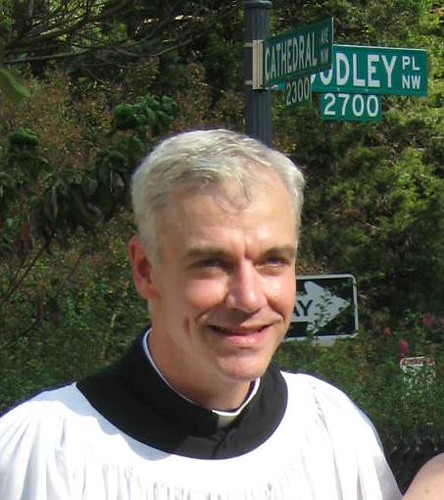
Sunday, June 05, 2011

An Ascended View of Things


A sermon for the Seventh Sunday of Easter, June 5, 2011. The lectionary readings are Acts 1:6-14 , Psalm 68:1-10, 33-36, 1 Peter 4:12-14, 5:6-11, and John 17:1-11 .


In this morning’s first reading we hear about the Ascension of Jesus. Always observed 40 days after Easter, Ascension was celebrated at All Souls and in Christian churches throughout the world on Thursday morning.

Jesus has ascended into heaven.
We say this each time we repeat the Nicene Creed.

And we hear about the Ascension again from this morning’s first reading. We hear how Jesus was taken from his disciples, taken up in the mystery of a cloud, and he left them.

He was lifted up. He was raised up, he was exalted. Not only is this an extension of his being lifted up on the cross for our sake, but really, it’s an image that explains the way Jesus sees others through the Gospels. And it’s a way that describes how Jesus enables US to see others.

His whole life, Jesus seems to view people from another perspective, from the perspective of his father in heaven. Though Jesus is among people—he walks the streets, the breathes the same dust, he eats the same food, in a hug or an embrace he the touches and holds the same human flesh; he never loses that ability to SEE from another point of view.

Throughout, he seems to operate from a different height. He sees things others don’t see. And he does not spend much time looking close-up at some of the things that the religious leaders of his day took great pains to stare at, dwell upon and magnify.

Jesus looked at people differently. When Zaccheus the tax collector approached Jesus, the other people saw Zaccheus as a horrible little man, a cheat, a swindler, and a sell-out to the Romans. But Jesus saw Zaccheus as a child of God. Jesus made no excuses for Zaccheus, but he called him to a new way of life.

The woman accused of adultery was seen by the crowd as no good, beyond being helped, with no self-respect and no sense of morality. But Jesus saw her differently, he saw her not by romanticizing her victimhood, but by calling out of her the very best that she could become.

With almost everyone he encounters, Jesus sees with God’s eyes, as though from a higher place. All the while, Jesus remains rooted, feet firmly on the ground, noticing even the lowly and the earthbound.

Through his life, death, resurrection and ascension, Jesus has opened for us the way to heaven. With his Spirit in us, we, with the Grace of God, we too can catch a glimpse of his perspective.

This morning, we baptize Michael Wadsworth, just like we baptized William two years ago. As we celebrate his baptism, remember, and give thanks for our own baptisms, we can reflect on how the baptismal water buoys us up. It lifts us up out of sin and death, and helps us to stand and run, and LIVE. Through baptism we are sealed with the knowledge that we are more than what we may appear. We are more than how we look, or how we talk, or what we know, or how we perform, or how much money we make, or how many friends we have, or what a good spouse or parent or child we are. We are lifted up above all of that by the love of Christ and we can view ourselves, even, from an ascended place; from a higher place.

What would it be like if we lived day to day, with the ability to see other people not in their failures and shortcomings, but in their potential? What would it be like for us to see ourselves, not the way we felt in elementary school, but as God sees us, not denying our faults, but seeing them in the context of our potential as children of God, capable of love that changes the world?

Austin Farrer, an English theologian who died in the 1960’s, writes of the ascension of Jesus by first reminding us of another ascension into heaven, the ascension of Elijah the prophet. It was Elijah who was thought to have ascended into heaven on the crests of flaming horses, horses on fire.

But with Jesus, the flame that carried him into heaven is what Farrer calls the “flame of Christ’s own sacrifice.” Look at the flame of a candle, he says, the flame always is drawn upward.

“All his life long Christ’s love burnt towards the heart of heaven in a bright fire, until he was wholly consumed in it, and went up in that fire to God. The fire is kindled on our altars, here Christ ascends in fire; the fire is kindled in the Christian heart, and we ascend. He says to us, Lift up your hearts; and we reply, We lift them up unto the Lord.” [The Crown of the Year, p. 34.]

In Holy Baptism we bless water with the Pascal Candle, a candle whose light begins at the Easter Vigil, with the first promise of resurrection. We give the baptized person a special candle—a candle that might be lit every year on the anniversary of his baptism, if he wants—and with that light, we say, “You have been enlightened by Christ. Walk always as a child of the light and keep the flame of faith alive in your heart.”

As we lift our hearts to God, it is especially appropriate that we claim for ourselves the full power of the Ascension. We can ask God to lift us up higher, to give us a new perspective on one another, to see ourselves more like God sees us, and finally, to be lifted into the very presence of God, Father, Son and Holy Ghost.

Sunday, May 29, 2011

God with Skin On

St. Joseph the Carpenter by Robert Campin, 1375-1444

A sermon for the Sixth Sunday of Easter, May 29, 2011. The lectionary readings are Acts 17:22-31, Psalm 66:7-18, 1 Peter 3:13-22 , and John 14:15-21 .

There’s an old story told by many a preacher. It’s a story that even appeared years ago in the Reader’s Digest. It tells of a child who can’t get to sleep. The child finally gets up and knocks on the door of the parents’ room, “I can’t sleep,” the child says. One parent gets up, goes with the child back to the room, gets the kid back into bed and tries to offer reassurance and comfort. “You know that we love you, right?” “Yes,” nods the child. “And you know that God loves you, and will be right here with you, and will watch over you all night long. You know that, too, don’t you?” And with that, the light is turned out and the child kissed good night. A few minutes later, the parents hear a knock on the door. It’s the child. “I know God is with me all night long. But can I sleep with you? Right now, I need God with skin on.”

“God with skin on” is the God I worship and serve, the God we celebrate and praise in this place, the God of Abraham and Sarah, of Moses and Miriam, the God of David and Bathsheba, the God of Mary and Joseph who became incarnate—who was made flesh—in order to live and walk and love and die and rise again for us. Ours is a God with skin on.

In our first lesson, from the Acts of the Apostles, Paul interacts with some sophisticated people. He’s in Athens and has come to the Areopagus (the hill of Ares, or for the Romans, Mars Hill). It was a great place of meeting in Athens. It was a place where the philosophers debated—the Epicureans, the Stoics, and all the other parties advocating one way of reason or truth as opposed to another. And while Paul respects his audience, and takes seriously their various beliefs, he nonetheless articulates his own view. Even more powerful, he spells out his belief borne out of his own experience.

Paul says, “As I went through your city, saw an altar with the inscription, ‘To an unknown god.’” “Well, I’m here to tell you,” says Paul, that “what you worship as unknown, I can proclaim to you. The God who made the world and everything in it, he is Lord of heaven and earth. God doesn’t live in shrines made by human hands, and is not served by human hands. God doesn’t need anything, but rather, it is God who has given to all mortals life and breath and all things.” Paul goes on to quote a saying that seems to have been known by everyone in Athens, “For we too are his offspring.” Since we are God’s offspring, there’s a connection we’re born with, we’re created in God’s image. We are flesh and blood, of divine design, consecrated, made holy, made new by the resurrection of Jesus Christ, and made new every day that we awaken with faith in him.

Jesus is God with skin on. And faith in Jesus Christ is an embodied faith. Faith is dead if it just exists in prayers that are said, or sung, or imagined. Faith only lives when it is embodied, when it is enacted. Though we don’t work our way into heaven, or gets God’s attention or blessing by working especially hard or holy; as St. James says, “What does it profit, my brethren, if a man says he has faith but has not works? Can his faith save him? If a brother or sister is ill-clad and in lack of daily food, and one of you says to them, "Go in peace, be warmed and filled," without giving them the things needed for the body, what does it profit? So faith by itself, if it has no works, is dead.” (James 2:14-17)

Faith without works, is dead. But often, I think many (and many of us, perhaps) work with faith every day, but we don’t always notice it, or make much of it. Too often, we tend to separate in our minds the things we do and think and say when we’re at church, from the things we do and say and think during the week at work. But if your body shows up for work, you are taking Christ there. If your heart is in the office, then a sanctified and redeemed soul is also at your desk.

Dorothy Sayers put it well when she complained that work and religion had, too much, become separate departments in life.

The Church’s approach to an intelligent carpenter [she complained] is usually confined to exhorting him not to be drunk and disorderly in his leisure hours, and to come to church on Sundays. What the Church should be telling him is this: that the very first demand that his religion makes upon him is that he should make good tables. Church, by all means, and decent forms of amusement, certainly—but what use is all that if in the very center of his life and occupation he is insulting God with bad carpentry? [Dorothy Sayers, Creed or Chaos? (London: Methuen, 1947), 58-59, quoted in Armand Larive, After Sunday: A Theology of Work (New York: Continuum, 2004), 64.]

If you work in politics or policy, let justice and the vision of God be a part of your work. If you teach, let the compassion and humor of Jesus be in your words and teaching. If you drive, then do so with purpose and clarity. If you write or make speeches, then do it with honesty and integrity. If you deal with people in any way, try to see them as fellow sisters and brothers made in the image of God. If you volunteer, then offer your service in gratitude for all God has done for you. Whether we make tables, or decision; whether we cook up a meal, or cook up a business deal, we are the Body of Christ moving and shaping the world. We—as we move, and pray, and struggle, and heal, and fall, and are raised up again—we are called to be “God with skin on.”

Frederick Buechner, the preacher and writer, reminds us that, “Moses at the burning bush was told to take off his shoes because the ground on which he stood was holy ground (Exodus 3:5), and incarnation means that all ground is holy ground because God not only made it but walked on it, ate and slept and worked and died on it. If we are saved anywhere, we are saved here. And what is saved is not some diaphanous distillation of our bodies and our earth, but our bodies and our earth themselves.” [Frederick Buechner, Wishful Thinking: a seeker's ABC (NY: Harper & Row, 1972) 43]

Jesus said to his disciples, “In a little wile the world will no longer see me, but you will see me; because I live, you also will live….They who have my commandments and keep them are those who love me… and I will love them and reveal myself to them.”

Graced by God, empowered by the Holy Spirit, may we show the risen Christ to one another and to the world. In the name of the Father, and of the Son, and of the Holy Ghost. Amen.

Sunday, May 22, 2011

A Roadmap for Now

The Stoning of St. Stephen

A sermon for the Fifth Sunday of Easter, May 22, 2011. The lectionary readings are Acts 7:55-60 , Psalm 31:1-5, 15-16, 1 Peter 2:2-10 , and John 14:1-14 .

It seems that Family Radio evangelist Harold Camping was wrong. The world did not end yesterday. We are still here. The red peonies are still blooming in the meditation garden out back. Baccalaureates and graduations are still going on. The beauty, the blessings, and all of the good things we know are still going on today.

The world didn’t end yesterday and that’s good news for most of us, but for some, it might have seemed like a welcome change. If you were out of work yesterday, it probably means you’re still out of work today. If you went to bed hungry, and the world went right on and the sun came up again, then you probably woke up hungry again. If things had come to a close last night, at least it would have taken away disease, warfare, destitution, abuse, and loneliness.

Harold Camping made a mistake in his calculations, but I think he makes a larger mistake, as well. In a radio interview last week, a Methodist minister named Brooks Morton put it well as he explained how, when he was first converted to Christianity, he believed that the end of the world was imminent. He put all of his energy into trying to figure out when the world would end. He put all of his imagination into himself—how he might clean up his act, how he might live a more pure and holy life. But he sees all that differently now.

Now [he says] I'm concerned about the people in my community who are homeless or the people in my community who are not going to have an air conditioning this summer when it gets up over 102 or 101, and the people this winter who, again, will not have coats. I have a much broader view of what God wants the church to do in the world.

It’s a Gospel passage that is often used at funerals, and as such, it gives a word of hope and assurance in the face of grief and uncertainty. But Jesus’ words also work for the day-to-day, the nitty-gritty, and any time and any place where trouble threatens. Jesus says “I am the way, and the truth, and the life.” But he doesn’t just say that so that we might have a roadmap to heaven. It’s a roadmap for living, a roadmap that involves a choice, a place, and posse.

“Let not your hearts be troubled” can sound so pious and “stained-glass-like” that we can miss some of the nuance in its meaning. “Don’t let your heart be troubled” suggests that we have a choice in the matter, and that’s good news. We’re not spineless victims when trouble comes. We might not have any power over the situation or the thing, but we can choose how we react. We can choose how we let it get to us. We can choose whether to let it trouble our heart or not.

In the reading from the Acts of the Apostles, we have the culmination of chapters 6 and 7. Stephen is chosen as the first deacon, someone to coordinate the distribution of food and care for the widows. But the religious leaders of his day don’t like the new arrangement. They feel threatened and plot to do him in. They throw together a mock trial to accuse Stephen of blasphemy. But there, even in the midst of the trial, Stephen makes a choice. He lets himself be emptied, so that the Holy Spirit has room to work. Stephen lets go of his will, his cleverness, his resourcefulness, his connections—and he let’s God take over. And there in the middle of his trial he receives a vision, a vision of heaven opening and God offering welcome and power and love. The mob can’t handle this, and Stephen is stoned to death, becoming the Church’s very first martyr.

Most of us are unlikely to be put in Stephen’s situation, but some of the binds we find ourselves in can seem just as tight, just as hopeless. St. Stephen and countless others have CHOSEN not to let their hearts be troubled, but to believe in God, and to believe that God has a way.

Jesus talks about a place for us. Like Tony sings to Maria in West Side Story, like Carrie Underwood sings today, like Virginia Woolf longed for in her essay—there’s something in us that longs for another place, a better place. But that place is not just physical. It’s not geographic. It’s psychological, it’s intellectual, it’s spiritual. We long for a place where our hearts, souls, and minds are free to grow and develop as God intends, unrestricted by custom or expectation or background or any other thing.

When Jesus says “In my father’s house there are many dwelling places,” he’s not talking public housing. He’s not talking retirement villages in Florida. He’s talking about SPACE, space that has the unique qualities both of being expansive and of being safe. Jesus goes before us to prepare a way, if we follow him, he leads us where we need to be.

When trouble comes, there’s a choice involved (as to how we respond) and there’s a place up ahead (where all becomes clear) but perhaps even more important; in addition to being promised a choice and a place, we also have a posse.

The Urban Dictionary defines posse as “your crew, your homies, a group of friends, people who may or may not have your back.” In Medieval Latin, the posse comitatus meant literally, the “power of the county.” It came to refer to a common law idea of a group of people who were given authority to catch the bad guys. And perhaps the term posse came to life most vividly in Westerns.
But those early apostles were called together as a posse, and given authority by the Holy Spirit. One by one, the disciples ask Jesus where he’s going, how do they get there, what do they do about this or that, and each time, Jesus answers with relationship. You have seen me and known me, you have known God the Father. Believe and we are in you. You have all you need. You have one another. Thomas asks more questions. Philip asks more questions, but later, after the crucifixion and resurrection, they begin to see what Jesus means. They have each other—they have their posse—but it’s a special band of people who’ve got your back, and when they get tired, the Holy Spirit steps in. We’re covered, we’re good to go, we’re protected, strengthened, and enlivened for the mission of God in our world.

Trouble comes, but we have a choice, we have place, and we have a posse. I’m glad the world didn’t end yesterday. Imagine the adventures we might miss. There’ll be trouble lurking—we can count on that—but we have a faith that sustains, no matter what.

W.H. Auden says it so beautifully when he writes in the chorus of his Christmas Oratorio,

He is the Way.
Follow Him through the Land of Unlikeness;
You will see rare beasts, and have unique adventures.

He is the Truth.
Seek Him in the Kingdom of Anxiety;
You will come to a great city that has expected your return for years.

He is the Life.
Love Him in the World of the Flesh;
And at your marriage all its occasions shall dance for joy.


In the name of the Father, and of the Son, and of the Holy Spirit. Amen.

Saturday, May 21, 2011

In Celebration of the Life of Jeffrey R. Workman

The Resurrection of Christ, by Fra Angelico (1395-1455)

A sermon preached at the Mass of the Resurrection celebrating the life of Jeff Workman (1957-2011), sometime organist and director of music at All Souls Memorial Episcopal Church.

Westminster Choir College offers a class called TH350 “Keyboard Harmony.” It is described as being “an intense exploration of and drill in musicianship-keyboard skills. Activities include score reading, transposition, modulation, clef reading, figured bass realization, harmonizing melodies, improvising, and lead sheet accompanying.” Jeff Workman either took TH350 or a class like it. And while he certainly mastered “score reading, modulation, clef reading, figured bass realization (whatever that is), improvising and the rest—I think Jeff excelled, in particular, in the area of transposition.

As all the musicians in the room well know, as many singers know, and as many hymn-singing churchgoers have experienced, to transpose is to set a tune, or a phrase—any collection of notes—up or down in pitch, maintaining the same space between intervals.

And so, a hymn might come from an older hymnal and be pitched higher than we’re used to singing today. The generous and beneficent choir organist will transpose the tune into a lower key that is more manageable and easier for more people to sing. Sometimes, in reality, a tenor is really a bass, and so the solo needs to be transposed to a different key. Transposition can happen in a very planned, formal way, but it can also happen at the spur of the moment, when the need arises, and whenever the circumstances at hand seem to call for it.

Jeff had a great gift for transposing—in his music, and in his life.

I saw this daily and weekly, but especially I noticed it at a funeral we hosted back in January. Trent Royster was a friend of All Souls whose partner sings in our choir when he is in the country. Trent, the young man who died, had a good friend who is an interfaith minister, and who coordinates a nondenominational, diverse spiritual community. We hosted the funeral, but the visiting minister and members of her community led the service. They had, however, asked Jeff Workman to play a piece by Bach as the prelude.

While we were honored to host the service, the worship was a little different from what we usually do. The Reverend and her friends set up a screen in the middle of the chancel, where they would later project a slide show. The service was to have begun with African drumming, but the drummers got stuck on the Metro. So Jeff improvised a little at the beginning. Later in the service, during a reflection, I noticed that the Reverend got up and whispered something to Jeff, who was sitting at the piano. Next came the slide show, with images of our friend who had died and it turned out that Jeff had been asked to “play something pretty” on the piano.

The slide projector came on, and Jeff played. But, man, did he ever play. The music he made was an improvisation that sounded like some extraordinary blend of Erik Satie, George Winston, and Charles Ives. It was so beautiful. It was so right. Through that music, as we watched images of Trent, our friend who had died, everyone in that room was brought closer together. That music was God’s way of using Jeff to nudge a group of very, very different people a little closer to each other.

After the funeral service, I thanked Jeff for his playing and especially for his out-of-the ordinary response to the visiting Reverend. He looked at me, confused. He had no idea what I meant. I said, “You know, when she asked you to play something on the spot, and you simply did it and led us all in worship.” And again, Jeff looked at me and seemed not to understand that he had done anything unusual. That was soooooo Jeff.

He could transpose music easily enough. He did it with hymns and anthems, and certainly gave me lots of leeway with chant, but Jeff could also transpose people and groups of people. He was able to use music, and humor, and laughter, and love to shift us a little in our understanding of music, in our knowledge of God, and in our experience of each other.

Some of us have seen the church where Jeff learned to play organ, where he lived, and have met some of the people who were so important throughout his life. Though Jeff moved from New Park, Pennsylvania to spend time in Princeton, Baltimore, Alexandria, Palo Alto, and places I’m sure I’m not even aware of, he was the same gifted person wherever he went. And in each place, he would do his work of transposing, of making it easier for everybody to fit in.

With folks who can only sing low, he’d modulate his music to involve them. For those who could only sing high, he’d go where they needed him most. Through it all, God was working through Jeff to accomplish a greater work, and that greater work was to help us understand that each of us might sing differently—it might be in harmony or out of harmony, it might be Gregorian chant, early music, Renaissance, or 12-tone—but we each have our place in God’s ear, in God’s dream of what we can be, in God’s eternal song in which we all play a part.

Jeff and I shared a lot of favorite music and we shared some dislikes. I did convince him to let us sing “Leaning on the everlasting arms of God” for a funeral but I promised him we would use it sparingly. Jeff approved of my love of anything Benjamin Britten, and especially in Britten’s use of Christopher Smart’s poem in Rejoice in the Lamb. I think of that music, that poem and that composer, and the complexity of both their lives, and I think it is quintessential Jeff Workman.

After rousing most of creation to rejoice, the poem moves even more outward and including, as it builds slowly, like (I imagine) the arms of God enfolding and reaching around us:

For H is a spirit and therefore he is God.
For K is king and therefore he is God.
For L is love and therefore he is God.
For M is musick and therefore he is God.
And therefore he is God.


And then the music grows into almost a frenzy, as the instruments join together,

For the harp rhimes are sing ring and the like.
For the harp rhimes are ring string and the like. . . .
For the flute rhimes are tooth youth and the like.
For the flute rhimes are suit mute and the like . . .

[and so it goes, on and on, until it shouts out ]

For the TRUMPET of God is a blessed intelligence and so are all the instruments in HEAVEN.
For GOD the father Almighty plays upon the HARP of stupendous magnitude and melody.
For at that time malignity ceases and the devils themselves are at peace.
For this time is perceptible to man by a remarkable stillness and serenity of soul.


The Trumpet of God is a blessed intelligence. God plays an instrument and even the devils are at peace. There is stillness and serenity of soul.

For us, living here, still, there is not a lot of stillness. But Jeff is in that other place, singing and laughing and no longer needing to transpose, since in heaven-- every note, every sound, every voice blends into perfection. We can be guided by his spirit. We can be led by his laughter. And can continue the holy work of transposition, as we encourage one another to sing, to pray, and to live.

Thanks be to God for the life of Jeff Workman. May his soul rest in peace, and may he rise in glory.

Sunday, May 15, 2011

Following the Good Shepherd (through 2010)

All Souls window in the narthex of the church.

The rector's annual report given in the form of a sermon on the Fourth Sunday of Easter, May 15, 2011. The lectionary readings are Acts 2:42-47 , Psalm 23 , 1 Peter 2:19-25 , and John 10:1-10 .


Today we hold our Annual Parish Meeting, which according to the church bylaws, is be held on the Third Sunday in May. The official meeting will be after the 11 a.m. Mass, in the undercroft, but this morning I’m reviving an old All Souls custom by offering my annual report in the form of a sermon. And the scriptures for today help me to do just that.

“Day by day,” we’re told, those early Christians “spent much time together in the temple… praising God and having the goodwill of all the people.” Most people experience us first through our worship. And we have continued to worship richly and fully. We blessed animals in October, and stretched limbs through yoga in Lent. Morning Prayer was said four days a week, Mass said three days a week, Stations of the Cross were prayed, people were blessed, healed, baptized, and buried. Through it all we have been led by amazing musicians. We spent most of 2011 with Philip Cave and said goodbye to him in November. It was then that we said hello to Jeff Workman and began what we imagined would be a new time of energy and growth in our music. And so, we keep on praying and we keep on singing.

The Acts of the Apostles describes a community of believers who “devoted themselves to the apostles’ teaching and fellowship, to the breaking of bread and the prayers. . . .”
We have broken lots of bread together. We have grown closer as we’ve continued our communion beyond the altar and through sharing fellowship in the undercroft, in homes, at nearby restaurants, at the parish picnic in Rock Creek Park. The foyer dinner program, the men’s fellowship, the Wise and Mature luncheons, a country western night, newcomers’ receptions— all helped us get to know one another and welcome others.

We’ve tried to be good stewards of all that we have and keep our household in order. All Souls are Green helped us conserve energy with new lighting, more accurate thermostats, recycling, and educational programs. The Bethany Guild was formed to help with organization, sprucing up, and general hospitality.

With the leadership of Dale Lewis, we began a visioning and planning process with MTFA architects and ambassadors from the congregation. We began putting dreams to paper and seeing what might work. We continued in that process as we prayed and plannned and met, and continue to work together toward accessibility and smarter space.

We’ve broken bread that nourished the body and the soul, but we’ve also broken bread that nourished the mind. The adult forum in 2010 began with Interfaith Dialogue, moved through the Evolution of Belief, continued with Living and Dying in Faith, and culminated with a mini-series on the Rapture. Our seminarian, Seth Walley, made his senior project our Rapture series, and Seth was one example of the nurturing power of our parish. We also encouraged Cameron Soulis in her year of discernment, sent Lisa Zaina off for her first year of seminary, cheered Shawn Strout on in his second year of seminary, and Norm Whitmire in his third year.

We shared our resources with others in need, giving sacrificially of time and our money. People from All Souls volunteered at Christ House, Transitional Housing, Habitat for Humanity, the Heifer Project, the Bishop Walker School, and the St. John Eye Hospital. In 2010, mission grants from the All Souls Endowment allowed us to support programs and ministries in Washington, DC with grants of over $30,000, and to international mission efforts with over $20,000. Volunteers and/or resources went to Haiti, Guatemala, Honduras, Israel, and South Africa.

It was in April of 2011 that the Rev. Sharron Dinnie, from Springs, South Africa, visited All Souls, preached on Sunday, and met with many in the parish. Having contributed money, we decided to do more, and so a handful of us visited Johannesburg in October. It was a trip that changed us, and we hope to return in spring of 2012.

Like those early disciples in the Acts of the Apostles, we were blessed by the Lord’s adding to our number. Some of this happened because All Souls became more visible. Even though we had enormous snowstorms during the early months of 2010, we were open, and people found us and prayed with us. When things warmed up, the garden guild continued its weekly conversation and outreach with the neighbors, and in June, we had a sizable delegation in the DC Pride Event. A number of parishioners staffed a booth at the Pride Festival, and helped people see that a living, breathing, moving Christian church can be a lot more fun and look a whole lot different from what they might have ever imagined.

Our second scripture reading, from the First Letter of Peter, speaks of endurance. It speaks of times when things don’t always go right or even seem to go fairly, but we endure together, by faith. The economic recession began to catch up with us in 2010 and we made some difficult decisions regarding the church budget. It made us lean and trim and some of our bones became visible. We did away with the full-time sexton’s position, relying instead on a cleaning service coming in for a few hours each week. We cut the parish administrator’s hours back.

Though our programs continued, and expectations remained, this meant that a parish of some 350 active parishioners had one full-time employee —the rector and the only priest. We were grateful that Father Worthley continued to volunteer on the Sundays he was in town, and many parishioners redoubled their efforts at volunteering and pitching-in, especially Clark Ball, Harriet Curry, Barry Huber, Terry Horan, Tom Mabon, and Oscar Prado. We have endured 2010, and a few more volunteers have joined us in 2011. But if we are to flourish, we will need to plan, and work, and contribute toward growth in new ways and at new levels.

The Gospel reminds us that today is often nicknamed Good Shepherd Sunday. It reminds us of our focus, the Shepherd around whom the flock gathers, by whom the sheep are led. We are reminded of our spiritual home that is here, and we are also pointed forward as we ask what it means for each of us to be called by name. And so the question comes up for us, “What does it mean for us to be the children of God?”

In our effort to be grown-up and serious Christians, I worry that we have sometimes forgotten what it means to be children. And we have forgotten to welcome the children, as Jesus taught. Granted, the children of All Souls are not always here, and when they are, it’s hard to keep up with them. But our classrooms are inadequate. Our time frame works against us. We have “made do” with too little. Busy families have come to us with low expectations for a Sunday school, and we have not done enough to raise those expectations. A few parents and a few other volunteers have helped as much as they could, but near the end of 2010, and into 2011, we have seen that much more is needed. And we will do more in the future.

The Good Shepherd calls us each by name. That happens not only at our birth, and at our baptism, and at our death, but it also happens throughout a life lived in faith, a life lived in openness to God’s continual calling. I’m grateful for those who have answered God’s calling to serve, and especially thank Bill Miller, Bob Publicover, and Jim Solomon, who complete their current terms on vestry. Larry Sturgeon continued his amazing service as volunteer treasurer. Our Endowment Board continued its fiscal leadership and guidance in mission support.

And thanks of a most special kind goes to Nancye Suggs, who completes her time as Senior Warden of Vestry. I’ve written elsewhere of my gratitude to Nancye, and we’ll be making a special presentation to her a little later on.

Thanks, in advance, to those who are hearing God’s call to stand for vestry in today’s election. I know that in saying “yes” to God (or at least saying “maybe”) they are, in effect, saying “no” to other things. I know that it’s no longer fashionable to serve on committees or to volunteer at church, and so, both I and the larger parish thank them for their service and their willingness to sacrifice for others.

Jesus says, “I come, that you might have life, and have it more abundantly.” We are so very blessed in this place. Every day that we are here is a gift. The building is beautiful, of course, and we give thanks for the way it shapes us in the beauty of holiness. But God blesses us even more richly in, and through, one another.

And so, thank you for the privilege of serving as your rector and thanks be to God for a very good year.

Thanks be to God who revives our soul,
who guides us and comforts us,
who nurtures and anoints,
who showers us with goodness and mercy, for ever and ever.

In the name of the Father, and of the Son, and of the Holy Ghost. Amen.

Friday, May 13, 2011

Waking Up


A sermon for the Third Sunday of Easter, May 8, 2011. The lectionary readings are Acts 2:14a,36-41, Psalm 116:1-3, 10-17, 1 Peter 1:17-23 , and Luke 24:13-35 .


What does it take to wake you up?

An alarm clock? A strong cup of coffee? An elbow in the rib?

Some wake up to a rooster crow, and others wake up to the sound of a trash truck.

For the cartoon characters Wallace and Gromit, it takes a little more than any of that. There’s an alarm that triggers a tea kettle, which makes steam which activates a giant hand that pokes the underside of the bed. Then there’s the smell of cheese—a good Stilton, usually—and then a spring-loaded bed, a slide, a chute that lands them into their clothes, with a cup of coffee made just like they like it.

We wake up, of course, not only in the morning, but all kinds of things can jolt us awake. Someone swerving into our lane on the road. A change in what we thought was to be our employment for the rest of our life. A child, a niece or nephew, or a grandchild. An unexpected test result from the doctor. And then, the other extreme, after worry and fear, we receive clean results from the doctor, and life is different from before.

We awaken in different ways and at different times.

In this morning’s first lesson, Peter follows in the footsteps of John the Baptist, trying to wake people up spiritually. His method is a bit blunt, a little like trying to wake up someone by throwing cold water on them. Peter says, “This Jesus, whom you allowed to be put to death—this is the Messiah.” “There’s a lot to answer for, so repent, get your lives in order, get right with God, be baptized and make a new start.”
Peter’s wake-up call seems effective, as the Acts of Apostles reports some three thousand persons were baptized and welcomed into the faith.

In some ways, the whole Easter Story is about the different ways in which people wake up to new faith, and wake up to new life.

One of the criminals who dies alongside Jesus wakes up the reality of the life that is possible. He doesn’t have to die alone. He doesn’t have to re-live his past over and over again. There’s another way, and so he asks for it. “Jesus, remember me, when you come into your kingdom.”

There’s Mary Magdalene who goes to the tomb that first Easter morning. She has awakened early from sleep, but after she finds the empty tomb, comes into contact with the gardner-who-is-really-God, Mary wakes up to the reality that Jesus is risen from the dead.

Last Sunday we heard how Thomas is trapped in the nightmare of his worries and fears and disbelieving. He struggles to accept what the others seem so easily to believe. Thomas wants proof, and then when proof stands right in front of him, Thomas, too, finally wakes up.

In the Gospel from Luke, the wake-up call is gentler, but no less dramatic. It’s later on Easter Day and Cleopas and one of the other disciples—perhaps Luke—are on their way home from Jerusalem. A stranger joins them, and the stranger seems to know all about what’s happened in Jerusalem, and he’s able to put it all into the context of scripture and prophecy.

The disciples and their guest go home. They continue the conversation, and almost casually, they share a meal. And then they notice a pattern. Just like in the Upper Room, just like that Passover Meal, just like the bread and cup they shared the night of Jesus’ arrest… Jesus “took the bread, blessed, and broke it, and gave it to them.” And their eyes are opened. They recognize him. They wake up.

They wake up to love: the love of God that would not leave them without comfort. The love of God that would befriend, that would die in the place of, that would extend mercy and compassion and forgiveness even from the cross.

They awaken to peace: peace that transcends any and all understanding; peace that is no wimpy peace—this is a peace that has defeated death, that has won victory over violence and put evil in the grave, slammed down the lid and danced on it.

They wake up to the possibility of forgiveness: forgiveness that is beyond imagination, beyond human doing, but by God, through Christ, propelled by the Holy Spirit forgiveness then moves through each of us as we extend it to one another. Forgiveness is never deserved, never earned, never timely, but is always a grace given.

Marc Andrus, the Bishop of California, reminds us that Buddhists do not have an exclusive hold on the idea of “wakefulness.” Though the word, “Buddha” means “the awakened one,” Christians also have a word—the proper name, “Gregory.” Gregory means “wakeful watching.” In some ways, at our baptism, we’re all given the name “Gregory,” in that we’re called as followers of Jesus to be as alert as possible, allowing the Spirit to keep us with eyes wide open, with all senses alive to the presence and movement of God.

Bishop Andrus recalls the particularly watchful Gregory the First, Christian pope in the Sixth Century. Gregory reflected on what happens when one prays when he wrote, “in that silence of the heart, while we keep watch within through contemplation, we are as if asleep to all things that are without.” But as Andrus points out, Gregory’s wakeful watching doesn’t end in contemplative prayer, but also finds expression in active prayer.

During his papacy, things were not always great for the people on Rome. As Andrus tells it,

The citizens of Rome were nearly confined within the walls of the city, the population swollen by the many refugees, and the conditions being like that of a siege. Pope Gregory donated the produce from his family estates and organized a vast network of other farms who donated alms in the form of food for the starving of Rome. This remarkable exercise of Christian leadership deeply endeared Gregory to the people of Rome, changing the status of the Pope with respect not to power but to authority born of love.


[See “Wakefulness” at Bishop Marc Andrus’ blog, http://bishopmarc.typepad.com/blog/2010/11/wakefulness.html.]


Life wakes us up, but unlike little children who sometimes wake up cranky and disoriented, we can choose how we respond when something wakes us up.

When a notorious terrorist is stopped, we are naturally relieved at some level, but we can choose how we wake up to that news—do we celebrate with savagery or do we allow God to awaken some deeper meaning for our lives?

As people around our country awaken to flood waters and devastation from storms, do we choose to remain sleepy and ignore their reality, or do we think with wakeful creativity and compassion how we might help?

It’s appropriate on this day to remember the many times perhaps we’ve been awakened by a mother—maybe gently, maybe creatively, maybe angrily. For the motherly invitations, nudges, shoves, we can be thankful, but we can also ask ourselves: Are we alert when God moves in motherly fashion and invites us to wake up?

The sufi and mystic and poet Rumi has a wonderful poem that strikes the spirit of an Emmaus awakening. He writes

The early breeze before dawn
is the keeper of secrets.
Don't go back to sleep!
It is time for prayer, it is time to ask for
what you really need.
Don't go back to sleep!
The door of the One who created the world
is always open.
Don't go back to sleep.

[Translation by Azima Melita Kolin and Maryam Mafi, "Rumi: Hidden Music" HarperCollins Publishers Ltd, 2001]

As followers of Jesus Christ we have been awakened to the possibility of new life.

There is a whole world to wake up to.

God invites us to wakeful watchfulness, so that we might help wake up the world.
In the name of the Father, and of the Son, and of the Holy Spirit. Amen.

Sunday, April 24, 2011

Naming Resurrection

Noli me tangere by Fra Angelico

A sermon for Easter Day, April 24, 2011. The lectionary readings are Acts 10:34-43 ,Psalm 118:1-2, 14-24 , Colossians 3:1-4 , and John 20:1-18 .


Sometimes when I’m with my in-laws, it gets confusing. It’s confusing not only because there’s usually a lot of food, and conversation is had among mouths full of good things. It’s not only confusing because everyone is talking at once. And not just because the languages spoken often become a hodgepodge of Tagalog, Ilonggo, English, or “Taglish.”

But there’s a particular word that comes up a lot, and every time I hear it, it makes me turn my head. The word is diyan (from nan diyan) and it means something like, “over there,” or “that one” and to me, it sounds just like my name. And so in that corner of the room there is a rapid-fire conversation, clickety-click, “John.” I turn my head, but they’re not talking to me. Then behind me, I hear another conversation, “John.” Again, it’s not me they mean. It’s finally gotten to the point that I just tune out anything that sounds like my name, so that several times someone has actually called me and I miss it, I’m hard of hearing!

In today’s Gospel, it’s only when Mary Magdalene hears her own name that she wakes up from the nightmare she’s been living. It’s only then that she realizes what has happened, that she realizes Jesus is speaking to her, and that she realizes that God has made a miracle.

Mary Magdalene goes to the tomb expecting to encounter death. She goes to pay her respects, perhaps to say a prayer for her friend. But instead, she hears her name, and nothing is ever the same again.

Names are important. For religious Jews, the true name of God is so holy that it’s never spoken, and it’s only written in four-letter symbol. Muslims use the 99 names of God to focus their prayer and to model their hearts more closely on the attributes of God. As Christians, we have inherited the Third Commandment, not to take the Lord’s name in vain. But we also gained a new name in Holy Baptism.

When I say that we gain a new name at baptism, I don’t mean the saint’s name that some old priests insist on a child having. But I meant that at some deep level, when we are baptized, we take on the name of Christ. And the new name we get from God is stronger than any other name anyone could ever call us.

This about Mary Magdalene for a minute. Who knows what names she was known by: daughter, sister, neighbor. Scripture refers to Mary Magdalene as having been cured from “seven demons” but it was only the creative interpretation of subsequent theologians who connected Mary’s demons with sexual sin. Even though scripture says nothing to suggest Mary had been a prostitute, later preaching and art history gave her that name, and it has stuck.

Perhaps we know what it is to be given a name that doesn’t fit. We can change a name legally, but sometimes it’s harder to change the name others have given us. But no matter what we may be called by others, no matter what name may arise when we look in the mirror, God has a new name for us.

In the Bible, there are times when people encountered God and God changed their name right then. It happened to Abram, and Sarai, and it happened to Simon. It happens still. Sometimes God calls us into a new name and we struggle or resist. But other times we pick up its sound, even though we may not hear it entirely, but we turn toward God and we follow. God whispers our true name at the moment of our birth. Our true name is sung like a lullaby at our baptism. And whenever times are rough, or especially good, God speaks our name and we can sometimes hear it. And then, when our eyes close to this world, when we die, God speaks our name loud, clear, and strong. The Good Shepherd knows each by his or her own true name. We can follow because we know his voice.

Most of you know that our parish has had an especially complicated Holy Week as we have struggled to come to terms with the death last weekend of our organist and choir director, Jeff Workman. Jeff and I could never decide how his name should appear in print—he went back and forth, whether Jeff or Jeffrey. One day I asked him if, since he was such a “fancy church musician and all,” perhaps we should call him Geoffrey, with a “G.” We both laughed and he suggested that if we did, we would need to refer to him also as “Master of the Quire,” with a “Q.” I don’t know what name Jeff goes by in heaven, but I assume he and God have agreed on something, and whatever that name is, it must sound like music the beauty of which is beyond even Jeff’s own imagining.

We are called by name in this life and into the next.

How our name might sound came to me in a new way through a novel I read a couple of years ago. Andre Aciman’s, Call Me by Your Name is about a love affair, but even to describe it as such is to degrade and over-simplify. It is a book about life. It is about growing older. It is about the people who move in and out of our lives, who touch us and change us, even if they end up far, far away.

As two characters in the novel discover their love for one another, the story builds to a place where one character says to the other, “Call me by your name.”

Think about that for a moment. What might it feel like to know someone so well, to love someone so deeply, to trust someone so thoroughly that you might call them not by their name, but by your own? Such a place would be an almost unbelievably intimate place, a place of excruciating vulnerability, a place of complete surrender, a place of absolute faith.

In today’s Gospel Jesus calls Mary by her own name, and her eyes are opened and she is able to see the resurrected Christ. She proclaims her faith, she names her love and gives her heart as she calls to him, “Rabboni!.” Master. Rabbi. Teacher.

In this exchange of names there is recognition and love and acceptance. Mary understands. She is given new strength to go and proclaim what she has seen. She goes with the joy of having been the first to recognize Jesus. Though Jesus calls Mary by her name, the level of trust and intimacy and love is similar to her having been called by his name.

Friends, this Easter, the good news is that we are called by his name. We are called to live into his name and to be his body in the world. It is a name that has power over death. It is a name that means love and joy and peace. It is a name that brings everlasting life.

Alleluia! Christ is risen!
The Lord is risen indeed. Alleluia!

Saturday, April 23, 2011

The Comparative Advantage of God


A sermon for the Easter Vigil, April 23, 2011. The lectionary readings are Exodus 14:10-31; 15:20-21 [Israel's deliverance at the Red Sea] , Ezekiel 37:1-14 [The valley of dry bones] , Psalm 114, Romans 6:3-11, and Matthew 28:1-10 .


As I was growing up, my father would often get my brother and me to help with projects around the house. We did things in the yard. We might re-shingle part of a roof. We would even take up old linoleum and put down new flooring. But then, there were some jobs that my father had the good sense to see, were simply beyond our ability. “You can’t beat somebody at their own trade,” he would say. And so a plumber would be called. Or a roofer. Or an arborist.

What Dad was talking about is basically what economists would call “comparative advantage.”

The Economist Paul Samuelson explains comparative advantage by giving the example of someone living in a small town. This woman is both the best lawyer and the best secretary in town. Though she might be tempted to try to do both, and indeed, would do a fine job—the notion of comparative advantage suggests that it would be to the common good, and to her advantage, to hire someone else to be the secretary. That way, she could put all of her resources into her legal practice. Turned the other way around, let’s imagine the person hired as secretary also had some skills in drafting simply briefs and legal documents. Even though the secretary could do some of the legal work, it would be to the comparative advantage of both for the secretary to be the best secretary possible and let the lawyer be the lawyer. This is the idea of comparative advantage. It’s an economic principle in trade, but it also has some practical implications in relationships of all kinds. It even has implications in the relationship we have with God.

The resurrection is about many things, but among them, I think it shows in no uncertain terms the comparative advantage of God.

It comes down to this: There are just some things God is better at than we are.
And yet, too often, we persist in trying to “play God.”

We keep calendars, and make plans, and arrange our lives (and the lives of other people) in such as way as to imagine that we are in control. Until something reminds us that we are not.

Our parish community has been reminded of just how out-of-control we are this week, with the death of our friend Jeff Workman, last weekend. As I’ve written elsewhere, I have little patience with easy explanations of death or overly-pious observations about death--- though I know full well, these are things we tell ourselves in an effort to restore calm, to suggest that there is a pattern to life, to imagine not only that “life” in under control, but at some level, to imagine that we are still in control. But death reminds us that life is unpredictable, tomorrow is unknown. Jesus wept. And the tears of God are with us in our weeping, until that day when “God shall wipe away all tears.”

Remembering the comparative advantage of God is difficult for us, partly because God has blessed us, his children, with so many gifts and abilities. We can make things. We sometimes can get along with each other. We are capable of heroic rescue and the ability to show enormous compassion. But we are also capable of oil spills, and nuclear accidents, and environmental abuse, and murder, and bigotry, and all of the other things that sometimes cause people to lose a belief in anything beyond ourselves. And yet, the brokenness of humanity is not an argument against God. Rather, it’s a reminder of just how much we need God.

We can work at peace. We can work at medicine and even the extension of life. We can work at peace and justice and freedom for all people. But at some point in all of this, there is a place for us to be ourselves—broken, fallible, sinful, human-- and to allow God to be God.

It is God who brought the people of Israel out of bondage and into freedom.
It is God who put bone to bone in the valley, and showed people just what he can do.
It is God who visited the Virgin Mary and commingled divinity with humanity.
It is God who raised Jesus from the dead.

And it is God who intervenes in our world, who intercedes in our lives, who interrupts our plans and makes for miracles—the miracle of life (a life fully lived here and now) and of life everlasting (the life to which we all are called to live in continual praise and love and laughter.)

Christ is risen from the dead,
trampling Death by death
and to those in the grave
bestowing Life. (Paschal troparion)


When we live as ourselves and allow God to be God, the full power of God is freed to reform and renew and raise us up into the fullness of Easter faith.

In the name of the Father, and of the Son, and of the Holy Ghost. Amen.

Thursday, April 21, 2011

The Blessing of Now

Jesus Washing His Disciples' Feet by Ford Madox Brown (1821-1893)

A sermon for Maundy Thursday, April 21, 2011. The lectionary readings are Exodus 12:1-4, (5-10), 11-14, Psalm 116:1, 10-17 , 1 Corinthians 11:23-26, and John 13:1-17, 31b-35 .

The Reading from Exodus describes a meal eaten on the run. Moses puts it bluntly, “Eat it with your loins girded, your sandals on your feet, and your staff in your hand. You shall eat it hurriedly.” Moses rushes the people through their meal because God is busy rushing through Egypt and making a way for the people to go forward, a way of freedom and new life.

When Jesus and his disciples gathered in an upper room to celebrate the Passover meal, they knew the tradition from Exodus, but I think Jesus chose this place and this time not to have a hurried meal. Instead, I think he chose this time and place in order to slow down. Biblical scholars argue about whether Jesus knew exactly what the next few days would bring, or whether he just sensed things were leading in a certain direction. But whatever the case, in the midst of confusion, uncertainty, worry, fear, perhaps some doubt—Jesus chose this supper as a chance to be with his friends and to savor ever minute. To taste the bread. To chew the olives. To smell the wine. To pray with eyes open wide.

Jesus speaks with them very gently. He talks about what might be ahead. When they become anxious, he offers calm. He shows them faith. He tries to prepare them spiritually, and as a symbol of servant hood and of cleaning away the old to make room for the new, Jesus washes their feet.

Simon Peter is uncomfortable with the idea. Probably for different reasons than we might be, but the reluctance, the vulnerability, the hesitation to yield to another, to allow another to touch, and wash, and offer— some of us might be in the same place as Simon Peter, and we might be uncomfortable.

And yet, just like Jesus tries to show Simon Peter that service involves not only giving, not only “doing unto;” but it also involves receiving, and allowing other to do, so Jesus offers us a way of service that makes for communion.

This act of washing feet not only recalls the service Jesus showed his disciples, but it also reminds us of where we are. We’re not back in First Century Palestine. We’re here, in Washington, DC. We don’t (all of us) have stylized, beautiful feet like in paintings or frescoes, we have what we have. And we have one another.

If you look around, you’ll see a sight that will never be repeated again: Each of these people, sitting where he or she is sitting, looking the way they do. This particular configuration of people, in this space, with the light just as it is—will never happen exactly like this again. Water, bread, wine, bodies, emotions…. they are all rare and endangered—endangered by the worries of tomorrow, by the regrets of yesterday, by the distractions of today,

And so, God invites us to be present in this evening. To be present now.

It’s not easy to be present. I remember a time when I was ANYWHERE but in the present. I was in seminary and it was one of the most unfocused and worrisome times of my life. It was Holy Week and I was confused. I was confused about the future, confused about the way my life was going, confused about my sexuality, my friendships, my understanding of God, my vocation… you name it, and it confused me and worried me. I was living with regrets from the past, and yet I was afraid to look ahead, feeling paralyzed by fears of the future. And then in church we sang a hymn.

Now the silence, now the peace,
Now the empty hands uplifted;
Now the kneeling, now the plea,
Now the Father’s arms in welcome;

Now the hearing, now the power,
Now the vessel brimmed for pouring;
Now the body, now the blood,
Now the joyful celebration;

Now the wedding, now the songs,
Now the heart forgiven, leaping;
Now the Spirit’s visitation,
Now the Son’s epiphany;
Now the Father’s blessing,
Now, now, now. (The Hymnal, no. 333, words by Jaroslav Vajda, 1919-2008)

God is here NOW.

Just as Jesus used the Upper Room as a time to be with his friends, so this night provides us an opportunity to be present. A lot has gone before us. The days ahead will bring their challenges, but we are here, in this place. And God is here, in this place, now.

Believing in Jesus

Mary anoints the feet of Jesus by Frank Wesley

From the All Souls Weekly for April 24, 2011.

On Monday of Holy Week we read John 12:1-11. We heard how Jesus visited Lazarus, Mary, and Martha soon after he had resuscitated Lazarus from the dead. It was during this visit that Mary took some expensive perfume and began to anoint the feet of Jesus. Judas, who very soon would betray Jesus, looked on and criticized Mary for her lavish gesture, suggesting that the perfume could have been sold and the money given to the poor. But Jesus answers him by suggesting that Judas is missing the point. The thing that matters most is not the perfume. The thing that matters is not even the act of Mary’s anointing.

Instead, the crucial thing is that Mary believes in Jesus. She believes that he has healed her brother and brought him back to life, and she believes that somehow Jesus is the key to ongoing life, to life at its richest, to life with God. The religious rulers were right to worry about this “belief in Jesus,” because such belief did, can, and always will change the world.

Belief in Jesus and his life-giving body (both the Body we receive in Holy Communion, and the Body we form with other believers) has sustained us this week at All Souls.

It was in the afternoon of Palm Sunday that some of us learned of the death of our friend Jeff Workman, our organist and director of music. After we waited for his family to be notified, we began to share the sad news with the vestry, the choir, and the extended parish community. Hearing that a young-looking man in his fifties had died of a heart attack did little to comfort or help make sense of the situation.

When someone dies, I do not care to hear theological justifications or pious clichés. I don’t care if God needs another angel and I don’t think there is always a “reason for everything.” Life is richer and more complex than that. Life (and death) is more mysterious.

But what I do know is that Jesus is the Way, the Truth, and the Life. Faith in him brought Lazarus out of the cave. Faith in Jesus helped the criminal of the cross to see paradise. Such faith will carry us through any difficulty, any trial, and any heartache. Belief in Jesus will carry us from Good Friday to Easter, from tears to laughter, and from death to life.

Sunday, April 10, 2011

Out of the cave

The Raising of Lazarus, Duccio, 1308-11. Kimbell Art Museum, Fort Worth, TX.

A sermon for the Fifth Sunday in Lent, April 10, 2011. The lectionary readings are Ezekiel 37:1-14, Psalm 130, Romans 8:6-11 , John 11:1-45 .

Some of you have visited the Roman catacombs, those underground caverns and passageways beneath the city of Rome, where many of the first Christians are buried. Those first believers would gather there to remember their beloved dead, and they would celebrate an early form of Communion, remembering the meal Christ celebrated with his disciples and breaking bread with one another. Some of these catacombs are decorated, and there are at least 40 images showing the Raising of Lazarus. Many from the 2nd century, these images usually show just two people. They show Jesus doing the raising, and they show Lazarus being raised-- Lazarus in his grave-clothes, all bandaged up, looking like a mummy. But by the 4th century, the picture changes.

The depiction changes as icons of the Raising of Lazarus still show Jesus and Lazarus, but they also begin to include Martha and Mary, Lazarus’ sisters. Also, there are the disciples, the crowd, the curious and nosey, and eventually the picture evolves to the point that usually one of the people is holding his nose. This illustrates that point that Lazarus has been dead for four days . . . and smells like it. Jesus says, “Lazarus, come out,” and Lazarus does. Jesus then says, “Unbind him, and let him go.” And so the people step forward. They do so as Sylvia Plath imagines it from Lazarus’ point of view,

The peanut-crunching crowd
Shoves in to see
Them unwrap me hand and foot—
The big strip tease.
Gentlemen, ladies
These are my hands
My knees. (“Lady Lazarus”)

The story of Lazarus comes at the end of Lent to prepare us for Holy Week. It has drama. It has compelling characters. And it begins to show us how Jesus can lead us from death into new life.

In the Orthodox tradition, the story of the raising of Lazarus gets extra special treatment. The Saturday before Palm Sunday is known as Lazarus Saturday—the focus of the day is on this sign of the power of Jesus, of life over death, of love over despair. For the Orthodox, the week leading up to Lazarus Saturday is spent as a sort of sustained meditation upon this story.

On Monday, Jesus hears that his friend is sick.
On Tuesday, it is heard that Lazarus is very sick and is dying.
On Wednesday, Lazarus is dead and is buried.
On Thursday, it is heard that for two days, Lazarus has been dead.
On Friday, there is expectation, for tomorrow Lazarus will be raised.

And so, throughout the liturgies of the week, Christians are invited to participate in the story, to live with it for a bit, to see where the story intersects with their own lives.

And if we think about it, there probably are intersections.

Sometimes when we hear the story of Jesus raising Lazarus, we can hear it like those earliest pictures portrayed it—as something that happened between two people, between Lazarus and Jesus, between one human being and his or her understanding of God. And maybe that is the way it makes sense to you. Perhaps religion is a very private thing for you, a well-kept secret between you and God. For some, the Raising of Lazarus can be explained away. It can be “psychologized” and over-spiritualized by suggesting that Lazarus was simply very ill, had a vision of Jesus coming to him, was healed, and then told the story of his healing in such a way that it was written down and repeated.

But for me, anyway, I think the Gospel, and life itself, suggests a more literal and a more crowded picture. It’s more in keeping with those icons that show Jesus, Lazarus, Mary and Martha, and crowds of people surrounding them. Rough around the edges, disorganized, and sometimes smelly—this is where God meets us. It’s precisely in these places where we get lost in a cave, God approaches and calls us out. We’re pulled into new life by the people God has sent to us.

The cave can look very different for each of us. Sometimes it’s dark and desolate. We feel like we have no hope. It can be in a crowded room, in a well-appointed home, in what looks to the outside world as a “happy family.” But inside (and inside ourselves) we feel lost. It’s as though a part of us were dead, or were dying.

Earlier, I used a few lines from a Sylvia Plath poem, and I did so almost disingenuously. I managed to find three or four lines in the poem that are funny and in my context could almost sound light, but I did the poem and the poet a disservice, really, by lightening it up. Plath’s poem is “beyond Good Friday.” It’s filled with dark and deathly images as she recalls her own suicide attempts, frames her own experience using images from the Holocaust, and describes much more the pain and misery and confusion of death, without revealing so much as a crack in which light might break in. For her, there seemed to be no light and it would only be a year after writing this poem that Plath accomplish her goal and end her life.

God calls often, “Lazarus, Come out.” “John, come out.” Whoever you may be, whatever your name is, even if you’ve forgotten what your name sounds like on God’s lips, Come out! However dark the cave may seem, come out.

And then, God sends angels to help unbind us. Often they are disguised in the oddest ways. Sometimes God sends a stranger, or someone incredibly annoying, or a doctor, or a specialist, or a friend who calls, or a neighbor who invites us out to walk or for coffee. Maybe it’s a televangelist or an infomercial or the side of a bus or an ad on the Metro—God works in mysterious ways to call us into life.

But at some point, it’s our job to stand up. Lazarus could have gotten cozy in the cave. Who knows, he might have found it a nice escape from being bossed around by two sisters, from having to work, from having to deal with the day-to-day. He could have dreaded the attention that it would cause, if he were to walk into the light. But instead, Lazarus listened to the voice of God, he moved out, and he allowed others to unbind him.

One of my favorite books has always been Walker Percy’s The Second Coming. In it, Will Barrett decides he has had enough of life. There’s no one to look after any more. He’s basically alone. He’s bored and tired and doesn’t really see any point to it all. And so he decides to put God to the test. Barrett goes into a cave to wait God out. If God exists, Barrett think, then God can save him. If not, he will die. And so he sits. And he waits.

But just as he’s settling into the cave, he begins to feel something in his mouth. It’s a pain and it increases. A toothache takes hold, one that becomes blindingly painful. It becomes so bad that Barrett eventually climbs out of the cave. Stumbling along in the woods, he meets a young woman, Allie, who is schizophrenic. In her own way, she is recovering, and together, they help each other out of the their “caves.” They help unbind one another. They lead one another into new life.

The Raising of Lazarus gives us a foreshadowing that we, too will be raised at the last day.

But it makes another, and perhaps even more important point: Even in the cave, Jesus is with us. Even in the dark, God calls and sends help to unbind us, to free us, and to bring us again into the light.

The words from a 6th century hymn invite us to come into the open, to move toward Bethany where Lazarus was raised, and to move toward Jerusalem, where Jesus will be raised

It sings the invitation:

Let us depart the mere material world, which is always in a state of flux, and hasten to meet Christ the Savior in Bethany. Let us then dine with Him and with this friend Lazarus and the apostles so that we may, by their prayers, be delivered from our past sins. If we cleanse every stain from our hearts, we shall see perfectly his divine resurrection, which he offered to us when he took away the tears of Mary and Martha. (St. Romanos the Melodist, 6th c.)

In the name of the Father, and of the Son, and of the Holy Ghost. Amen.

Sunday, April 03, 2011

Seeing Clearly

A sermon for the Fourth Sunday in Lent, April 3, 2011. The lectionary readings are 1 Samuel 16:1-13, Psalm 23, Ephesians 5:8-14 , and John 9:1-41 .

Many of you are familiar with St. Teresa of Avila, the 16th century woman who was part mystic, part nun and part religious reformer, but she was also a real person with real feelings and emotions. She rode all over Spain in a horse and wagon, founding convents and confronting local authorities, and did it all with a bad back that gave her almost constant pain. She said her prayers, but her prayers were honest. At one point tired, feeling defeated and stuck in the mud, she is reported to have shaken her fist at heaven and said simply, “God, if this is the way you treat your friends, it’s no wonder you have so few of them.”

Sometimes it’s lonely being a Christian. The life of faith can feel that way sometimes. We wonder why it’s so hard. We wonder why things don’t come easier. We might even wonder what the use of believing in God is, since we (as well as others) suffer, are met with challenge, and face illness and death. Other Christians do dumb things and sometimes we’re asked to explain or defend them: non-Christians love to bring up the crusades, or problems in the Roman Catholic Church, or the crazy preacher in Florida who can do nothing better with his time than burn the holy books of other religions. And while we are responsible only for what WE know, and what WE see, we wonder, “Why can’t every Sunday be Rose Sunday, ‘Laetare,’ filled with rejoicing and life and joy?” Why can’t life be filled with roses?

But we know that every Sunday is not Rose Sunday, and some days seem more to be filled with weeds than blossoms. But we’re not alone in getting cut by thorns as we reach for roses. We’re not alone, in the history of faith, with our struggles. Lovers of God have dealt with this from early on.

The church that first heard Saint John’s Gospel knew something about pain and rejection. John warns them, “They will persecute you,” (15:20). “They will put you out of the synagogues; indeed, the hour is coming when whoever kills you will think he is offering service to God,” John says. (16:2)

In today’s Gospel we hear about a man who is healed. It’s similar to another story in John’s Gospel in which another man is also healed, and he is told to take up his pallet and walk. In both stories, the healed person gets into trouble. Neither person was initially asking for help. They weren’t asking for healing. They certainly weren’t asking to be put on the radar of the religious authorities and be made the center of attention for their scrutiny. But that’s what happens and they’re left to try to explain the mystery of God’s ways.

I use the term, “religious authorities” with some intention, so maybe I’ll say a word about this. Sometimes people say the Gospel of John is anti-Semitic because, over and over again it talks about “the Jews.” “The Jews” did not believe that the man born blind had received his sight. People fear “the Jews,” and it’s “the Jews” who are putting people out of the synagogue. But when the Gospel of John says “the Jews” he doesn’t mean the whole people, or even the whole religious people. He means the Jewish authorities, the religious leaders, leaders who (in his day and in many other times become self-obsessed and lose a sense of belonging to God). The Jewish people, many of whom followed Jesus, had very little to say in the matter.

In today’s Gospel and in many other places, the religious authorities miss the point of what’s going on right before their eyes. They become caught up with when the healing is done, how it is done, who sinned and who is paying for that sin… They are blind to what God is doing and blind to how God is healing. It’s the seeing, who are blind.

But the “blind man,” sees. And our scriptures today invite us to see.

In the first lesson the prophet Samuel goes in search of a new king. The sons of Jesse are paraded in front of him, but none of them measures up, though each might initially look like a potential king. But it’s the one who’s out keeping the sheep, David, who is called. Samuel stops, looks and prays. And Samuel sees.

The Gospel about the man born blind is read on this Fourth Sunday in Lent, as we move with Jesus into Jerusalem. With Jesus, we attempt to sort out the various voices and appearances, the things that clutter up our vision and get in the way. And with the blind man who receives his sight, we are invited to stop, look, pray and see.

The religious leaders of Jesus’ day can’t see because of several things blocking their sight.
They don’t think it’s possible to see healing from Jesus.
They don’t expect to see anything new.
They have firm ideas about what they might see, and so they’re not able to see anything different.

Some years ago, I was visiting Jerusalem with a group from my seminary. On one morning, we had some time by ourselves, and so I went back to the Church of the Holy Sepulchre with the intention of simply hanging out for a while. I thought I could maybe find a quiet place somewhere in that holy space and simply absorb some of the spirit. I found a seat in an empty chapel and began praying. At one point, I opened my eyes and realized a couple of older, Orthodox nuns were had come in and were sitting near me. Then a few more people came in. And then I began to hear a tremendous racket. A verger was leading a procession right into this chapel—the verger had a great big pole and was smacking it on the floor as this long procession of monks and priests and other important-looking people walked right into the chapel where I was—where I was now trapped. I couldn’t go out the door I had come in, since there was a parade of people coming in. And yet I couldn’t see any other exit. There I sat, this tall guy wearing a bright red shirt and khakis, in the midst of this sea of black clothing, incense and worship in another language.

And yet, I felt invisible. It was as thought no one even saw me. My presence there was so odd, so unexpected, so unreal as compared with what they ordinarily encountered in that space, that there was an aspect of invisibility to me. I leaned over to a woman near me and asked her, “Excuse me, how might I get out?” She ignored me. Then I asked louder, and it was as though I had broken some kind of spell. She looked at me with a look of absolute horror, but seemed to understand my question, and pointed to a the iconostasis, the screen covered with icons, and I so I got up and headed that way, saw a door and made my escape.

I wonder how often that happens in other ways in my life? How often am I blinded to what might be right before me because I don’t expect something new, or don’t quite recognize something that has changed, or perhaps don’t slow down long enough in what I’m doing to notice what is before me?

The religious leaders missed the work of God right before their eyes. But with eyes of faith, the blind man regained his sight, and many who followed Jesus had their eyes opened to the possibilities and promises of God.

Even though every day doesn’t contain roses, and even though the healing of our own ailments may come more slowly than we might hope, the loving power of Christ is to heal and to help, and he offers us his love this day.

May the love of Jesus Christ open our eyes to the depths of God’s love and the ways in which we might be a part of God’s healing in the world.

In the name of the Father and of the Son and of the Holy Ghost.

Amen.

Saturday, April 02, 2011

Celebrating the Life of Regina Dading

The Sixth Station: Veronica wipes the Brow of the Lord

A sermon for the celebration of the life of Regina Dading on April 2, 2011. The scripture readings are Isaiah 25:6-9 and John 14:1-6.

There’s a picture in the back of the church of Regina and a pigeon has landed on her hand. For a long time, that was all I knew of Regina Dading. That picture was on the cover of the All Souls Parish Profile, the kind of “resume of the church” that was used to look for a new priest after Father John David left in 2005. And so, some time early in 2007 I downloaded the parish profile from your website and I entered the search process. Whenever I looked at the profile to remind myself of some aspect of All Souls, or before I wrote anything for the search committee, or prepared to meet with people from the committee or the vestry, I would take out that parish profile, and would see, first of all, the picture of that lady with the pigeon.

I decided that she must be a character. First of all, she must be the sort of character a pigeon would like—and I don’t think pigeons like everyone. But second, I realized that she must also be the kind of person who has a good enough sense of humor that she would not only allow the church to put her picture on the cover of the parish profile, but that she also just might get a huge kick out of it. I’ve only recently learned that the picture was taken in Italy, when Regina and some of the people from church took a tour. So that’s an Italian pigeon, which explains why it would have such good taste as to pick out Regina for a friend.

Because of her picture on the cover of the parish profile, Regina, for me, was the “face of All Souls.” She, and the other pictures and the text, were all I had to go on—but as I’ve learned over time, I don’t think the search committee could have found a better picture to personify the history, the humor, the tenacity, the quirkiness, and the deep devotion and love for God that are so much of the spirit of this place.

In today’s Gospel, Jesus says, “In my father’s house there are many rooms.” The Father’s House is a place Jesus has prepared for us, so when we get there, it will seem familiar in all the important ways. The Father’s House is no doubt a bit brighter now that Regina is there. And it’s probably a little bit louder, with the combined giggles of Regina and Helen Anderson, and so many of the people they loved in this place who have now gone to a place of even deeper fellowship, better food (even better beer), and a place where, as scripture says, God shelters them with his presence. “[Where] they shall hunger no more, neither thirst any more; the sun shall not strike them, nor any scorching heat. For the Lamb in the midst of the throne will be their shepherd, and he will guide them to springs of living water; and God will wipe away every tear from their eyes.” (Revelation 7:15-16)

Though Regina is in another place, much of her spirit continues to guide and teach us, to inspire us to be our best, and to remind us that there is no separation between the Holy Table of God (the Altar) and the holy tables of fellowship in the undercroft, or in our homes, or anywhere we might break bread with another person and share the love of God in Jesus Christ.

I don’t know what Regina thought about the Stations of the Cross that were installed at All Souls a few years ago. But there’s one station, in particular, that makes me think of Regina. It’s the Sixth Station.

Traditionally, the Sixth Station over there is the one where we remember the moment that a woman wiped the face of Jesus. Tradition has given her the name Veronica. But it’s not that someone was actually named Veronica. The name comes from “vera icon,” meaning “true image.”
And so Veronica is an icon of what it looks like to love God. In some ways, the fact that she is a woman who simply showed up and did what was needed at the right time, a woman whose name is not known by many—Veronica symbolizes so many women who have kept the faith over the centuries. Certainly in this parish, during the leanest times, it was the women who kept things going. They kept the doors open, the silver polished, and the stomachs full. They kept the stomachs full not just of church members, but of anyone who would stop by, or anyone in need. Though the Church remembers Veronica at the Sixth Station as wiping the brow of the Lord Jesus on his way to Calvary, tradition does not say what Veronica did next. But I think that if she were anything like the “church women” I know, she probably went home to put food on the table, knowing that people would soon be hungry and need to do something with their grief. Since it’s hard to know what to do with grief, with anxiety, with fear… it’s as good as anything to share a meal with friends. In such a meal we find strength. We find hope. We find God.

As we share Holy Communion, we can do so in the faith and knowledge that Regina is with us celebrating, laughing, and loving. As we continue to share a meal in the undercroft afterwards, again her spirit will be very much a part of what we do. And finally, even as we leave the church later today, her love and her witness to God’s love go with us and help us to find our way today and in the days ahead.

Thanks be to God for Regina, for her laughter and for her love.

In the name of the Father, and of the Son, and of the Holy Ghost. Amen.


Subscribe in a reader

Religion Blogs - Blog Top Sites